


Hisense PX4-Pro vs PX3-Pro: Which UST Projector Should You Buy?

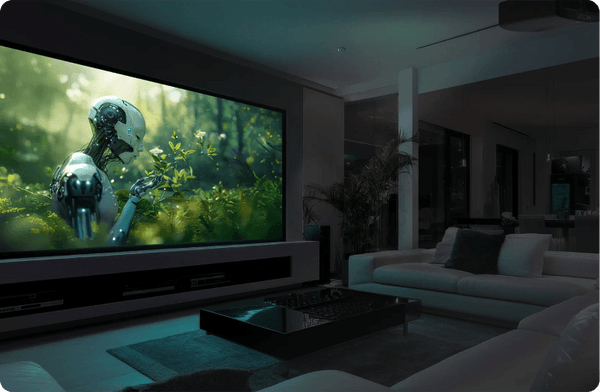
Put an ultra short throw projector on a low credenza a few inches off your wall and a 100- to 150-inch image replaces a flat-panel TV without ceiling conduits or room-crossing light beams. Hisense builds two of the strongest triple-laser consoles in this class, separated right now by a $1,500 price gap: the Hisense PX3-Pro at $2,497.97 (regularly $3,497.97) and the Hisense PX4-Pro at $3,997.97 (regularly $4,497.97).
Both projectors share Hisense's pure RGB triple-laser architecture with zero color wheel and zero brightness-robbing color filter, full Dolby Vision, HDR10+, and IMAX Enhanced certification, crisp 0.47-inch DLP 4K pixel shifting, and low-latency high-refresh gaming. Choosing between them comes down to how you want to spend that $1,500 difference: the PX3-Pro channels maximum value into 80- to 150-inch cinema and leaves substantial budget for a dedicated UST ambient-light-rejecting screen, while the PX4-Pro adds a 7-step manual optical iris for deeper dark-room blacks, higher bright-room headroom, a tighter 0.20:1 throw focused up to 200 inches, a calmer fan profile, four HDMI inputs, FreeSync VRR, Apple AirPlay, and a 66-watt Devialet 4.0.2 sound system.

Hisense PX3-Pro
- Filterless RGB triple laser (3,000 ANSI lumens): Rated 110% BT.2020 color gamut with measured 97% DCI-P3 and 96% post-calibration BT.2020 coverage.
- Proven dark-room contrast: 3,000:1 rated native contrast (measured 3,200:1 calibrated in SDR and up to 6,350:1 in HDR10 IMAX Mode).
- Full HDR and Xbox-ready gaming: Dolby Vision, HDR10+, IMAX Enhanced, Active 3D, and Designed for Xbox play with 17 ms lag at 4K/60 Hz and 5 ms at 1080p/240 Hz.
- Google TV and 50W Harman Kardon audio: Native Netflix, three HDMI ports (two HDMI 2.1, one eARC), 3.5mm and optical audio out, and a $1,500 head start toward your screen.

Hisense PX4-Pro
- 7-step optical iris + 3,500 ANSI lumens: Dial down excess light on 100" to 120" screens to reach 4,144:1 to 4,873:1 measured native HDR contrast, or open it for daytime viewing.
- Shorter 0.20:1 throw up to 200 inches: Sits 2.0 inches closer to the wall at 120" than the PX3-Pro and focuses cleanly up to a 200-inch diagonal.
- Four HDMI ports and VRR gaming: Two HDMI 2.1 inputs plus two HDMI 2.0 inputs (eARC on HDMI 3), AMD FreeSync Premium VRR (1080p at 48 to 240 Hz), and 1 ms 2K/240 Hz DLP Turbo mode.
- 66W Devialet 4.0.2 Atmos + VIDAA with AirPlay: Six built-in speakers with up-firing height channels, noticeably quieter fan pitch, Wi-Fi 7, and Gigabit Ethernet.
Which Hisense UST Projector Fits Your Room and Budget?
Because both models use a 0.47-inch Texas Instruments DLP chipset and pure RGB triple-laser light source, their core color volume and pixel sharpness belong to the same family. Where they separate is optical light control, throw geometry, input count, acoustic refinement, and how far your total room budget stretches once you factor in a proper UST screen.
| Room and Viewing Scenario | Recommended Fit | Why It Works on Screen |
|---|---|---|
| Total projector + ALR screen budget around $3,500 to $4,500 | Hisense PX3-Pro ($2,497.97) | A UST projector paired with a real lenticular or Fresnel ALR screen consistently outperforms a pricier projector aimed at bare drywall. Saving $1,500 on the PX3-Pro funds a high-grade 100" or 120" UST screen immediately. |
| Dedicated dark room or dual-purpose 100" to 120" theater | Hisense PX4-Pro ($3,997.97) (or PX3-Pro on a tighter budget) | Closing the PX4-Pro's manual iris to Manual 3 or Manual 4 lowers the black floor and lifts measured native HDR contrast above 4,100:1 to 4,600:1 while keeping 1,529 to 1,733 compensated lumens on screen. |
| Living room with daytime windows, recessed LEDs, and sports | Hisense PX4-Pro ($3,997.97) | Higher baseline output (2,088 accurate HDR lumens with iris open) plus a usable Brightness Enhancer Standard mode (+16.2% white output) gives mixed-light rooms an extra gear without wrecking skin tones. |
| Shallow media credenza or oversized 150" to 200" wall | Hisense PX4-Pro ($3,997.97) | The 0.20:1 lens saves 2.4 inches of total cabinet depth at 120 inches (21.6" vs 24.0") and 3.2 inches at 150 inches, and its motorized focus extends to 200 inches (PX3-Pro stops at 150 inches). |
| Multi-console household with AVR or eARC soundbar | Hisense PX4-Pro ($3,997.97) for 3 sources + eARC; PX3-Pro for 2 sources + eARC | With HDMI 3 dedicated to an eARC sound system, the four-port PX4-Pro still leaves three open HDMI inputs for a PS5, Xbox Series X, and media player, while the three-port PX3-Pro leaves two HDMI 2.1 ports open. |
| Google TV ecosystem vs Apple AirPlay and strong built-in sound | PX3-Pro for Google TV; PX4-Pro for AirPlay + 4.0.2 audio | PX3-Pro runs full Google TV with Play Store apps and 50W Harman Kardon front speakers; PX4-Pro runs fast VIDAA OS with native Netflix, built-in Apple AirPlay, and 66W Devialet 4.0.2 Atmos speakers. |
Full Specifications: Hisense PX3-Pro vs PX4-Pro
Specifications below combine live ProjectorScreen.com SKU data (verified November 15, 2026) with Hisense USA's official technical specification sheets and our published lab measurements.
| Specification | Hisense PX3-Pro | Hisense PX4-Pro |
|---|---|---|
| Current Price (Regular List) | $2,497.97 ($3,497.97 list) · In Stock | $3,997.97 ($4,497.97 list) · In Stock |
| SKU and Stocked Finish |
Hisense-PX3-PRO · Dark metallic gray/black console (single finish SKU) |
Hisense-PX4-PRO · Black body with brushed silver front and curved top grille (single finish SKU) |
| Light Engine and Laser Life | LPU pure R+G+B triple laser (filterless, zero color wheel) · 25,000+ hours | LPU 3.0 pure R+G+B triple laser (filterless, zero color wheel) · 25,000+ hours |
| Wide Color Gamut Coverage | 110% BT.2020 rated (filterless); 98% pre-cal / 96% post-cal BT.2020 and 97% DCI-P3 measured | 118% BT.2020 rated (filterless, factory ΔE ≤ 0.9); 94.1% Rec.2020 xy OOTB measured in HDR Theater |
| Brightness (Rated / Calibrated Lab) | 3,000 ANSI lumens rated; 2,580 lumens calibrated D65 (James LaBove 9-point UST average); ~1,740 StudioTek-compensated lumens in matched SDR Theater check | Up to 3,500 ANSI lumens rated; 2,043 (SDR Theater Night) and 2,088 (HDR Theater) StudioTek-compensated lumens with iris open; up to 3,295 in Vivid/Ultra |
| Imaging Chip and 4K Method | 0.47" TI DMD DLP · 4-position pixel-shifted 4K UHD (3840 × 2160) | 0.47" TI DMD DLP (DLPC8445 controller) · 4-position pixel-shifted 4K UHD (3840 × 2160) |
| Aperture and Contrast Control | Fixed optical aperture · 3,000:1 rated native contrast (3,200:1 calibrated SDR; 6,350:1 peak native in HDR10 IMAX Mode) | 7-step manual optical iris + 2 Cinema presets + CineBlack Pro · 6,500:1 rated with iris (3,021:1 open to 4,873:1 at Manual 7 in HDR Theater; 5,545:1 at Iris 6 in SDR) |
| HDR Formats and Tone Management | Dolby Vision, HDR10+, HDR10, HLG, IMAX Enhanced, Filmmaker Mode, switchable Dynamic Tone Mapping and Active Contrast | Dolby Vision (Dark, Bright, Game), HDR10+, HDR10, HLG, IMAX Enhanced, Filmmaker Mode, CineBlack Pro EBL tone management |
| 3D Support | Active DLP-Link 3D Ready (3D glasses sold separately) | Active DLP-Link 3D Ready (3D glasses sold separately) |
| Throw Ratio and Image Size | 0.22:1 ultra short throw · 80" to 150" diagonal · Motorized focus + Auto Keystone | 0.20:1 ultra short throw · 80" to 200" diagonal · Motorized focus + Auto Screen Fit (100" to 120") |
| Wall Clearance (Rear of Chassis to Screen) | 80": 4.7" · 100": 8.5" · 120": 12.3" · 150": 18.1" | 80": 3.6" · 100": 7.0" · 120": 10.3" · 150": 15.3" · 200": 23.6" |
| HDMI Ports and Audio Return | 3 HDMI total: 2× HDMI 2.1 (ALLM) + 1× HDMI 2.0 (4K/60 Hz with eARC on HDMI 3) | 4 HDMI total: 2× HDMI 2.1 (ALLM) + 2× HDMI 2.0 (eARC on HDMI 3) |
| Gaming Refresh, VRR, and Input Lag | Designed for Xbox · 4K/60 Hz (17 ms measured) · 1080p up to 240 Hz HSR (5 ms measured) · ALLM (4K/120 signals accepted and displayed at 4K/60 Hz) | 4K/60 Hz native · AMD FreeSync Premium + HDMI VRR (1080p at 48 to 240 Hz) · 1 ms rated at 2K/240 Hz (DLP Turbo) · ALLM (4K/120 accepted and downconverted to 60 Hz) |
| Built-In Audio and Audio Outputs | 50W 2.0 front-firing Harman Kardon (Dolby Atmos, Dolby Digital) · HDMI eARC, 1× Optical, 1× 3.5mm headphone out, Bluetooth | 66W 6-speaker 4.0.2 Devialet with up-firing drivers (Dolby Atmos, DTS:X, 7-band EQ per mode) · HDMI eARC, 1× Optical, Bluetooth Sound Send |
| Smart OS, Wireless, and Control | Google TV (native Netflix) · Chromecast, AirPlay 2 · Wi-Fi 6E, Bluetooth 5.3, 100M Ethernet, Control4, 1× USB 3.0 + 1× USB 2.0 | VIDAA OS (native Netflix) · Apple AirPlay, Miracast, Google Home · Wi-Fi 7, Bluetooth 5.4, Gigabit Ethernet, Control4, 1× USB 3.0 (rear) + 1× USB 2.0 (side) |
| Dimensions, Weight, and Mounting | 21.7" W × 4.8" H × 11.7" D · 19.8 lbs · 250W · Tabletop console standard (ceiling mount sold separately) | 21.3" W × 5.6" H × 11.3" D · 18.3 lbs · 250W · Tabletop console standard (ceiling mount sold separately) |
| In the Box and Warranty | Backlit voice remote (2× AAA), power cord, lens cleaning kit, Quick Start Guide · 2-Year Hisense Limited Warranty | Backlit voice remote, power cord, lens cleaning kit, Quick Start Guide · 2-Year Hisense Limited Warranty |
Brightness, Iris Contrast, and Dark-Room Control
Comparing bench numbers across two reviews requires keeping each test setup clear. ProjectorScreen.com reviewer James LaBove tested and calibrated the Hisense PX3-Pro in October 2024 on a 0.6-gain UST ALR screen, where it delivered 106 nits at D65 after calibration (averaging 2,580 lumens across a 9-zone, 3-angle UST grid, with UST lumen tolerances noted at plus or minus 25%), 3,200:1 native contrast in SDR Filmmaker, and a standout 0.0168-nit black floor for 6,350:1 native contrast in HDR10 IMAX Mode. A year later, in our 2025 UST Projector Showdown reported by Brian Gluck and directed by Phil Jones, our six-judge panel ranked the PX3-Pro second overall among six triple-laser USTs on matched 100-inch Spectra Projection Vantage (0.5-gain) screens.
When I tested the Hisense PX4-Pro in August 2026 using a Colorimetry Research CR-250 spectroradiometer and a profiled CR-100 colorimeter on a 100-inch Stewart StudioTek 100 screen (alongside real-room viewing on a 100-inch Spectra Projection Phoenix and a 150-inch Spectra Equinox), I also placed a PX3-Pro on the same bench for a matched SDR Theater check. Under identical StudioTek-compensated conditions, the PX3-Pro produced roughly 1,740 compensated lumens at 3,340:1 sequential contrast, while the PX4-Pro opened at 2,043 compensated lumens in SDR Theater Night and 2,088 lumens in calibrated HDR Theater at 3,021:1.
| Projector and Optical State | Measured Output (Matched ST100 Basis) | Native Sequential Contrast | Best Room Application |
|---|---|---|---|
| PX3-Pro · SDR Theater (Fixed Aperture) | ~1,740 compensated lm (106 nits on 0.6-gain ALR in standalone review) | ~3,340:1 (up to 6,350:1 in HDR10 IMAX Mode) | Strong all-around dark-room and moderate-light living-room baseline at 100" to 120". |
| PX4-Pro · HDR Theater, Iris Off (Open) | 2,088 compensated lm (100% reference output) | 3,021:1 | 130" to 150" screens or living rooms with ambient light where every accurate lumen counts. |
| PX4-Pro · SDR Theater Night, Iris Manual 2 | ~1,796 compensated lm | 4,147:1 | Stays brighter than our matched PX3-Pro SDR reading while simultaneously lifting native contrast by 24%. |
| PX4-Pro · HDR Theater, Iris Manual 3 | 1,733 compensated lm (83.0% of open iris) | 4,144:1 | Sweet-spot setting for 100" to 120" screens, trading surplus glare for a 37% jump in native contrast. |
| PX4-Pro · HDR Theater, Iris Manual 4 | 1,529 compensated lm (73.2% of open iris) | 4,629:1 (reaches 4,873:1 at Manual 7) | Dedicated lights-out cinema on 100" to 110" screens (~124 nits on a 0.7-gain UST screen). |
| PX4-Pro · HDR Theater + Brightness Enhancer Standard | +16.2% white luminance (213.4 to 247.9 nits) | Open-iris mixed-light boost (Vivid/High reaches ~2,850 lm in SDR) | Daytime sports and family room viewing where ambient visibility takes priority over D65 neutrality. |
That iris curve is the PX4-Pro's signature optical advantage. On a 100-inch screen in a darkened room, 2,000-plus accurate lumens can actually feel brighter than your eyes want during shadowy scenes. Closing the PX4-Pro's fixed iris to Manual 3 or Manual 4 converts that surplus light directly into deeper letterbox bars and richer shadow separation, while opening the iris and engaging Brightness Enhancer Standard gives you a clean bright-room gear that the PX3-Pro's unwatchably green Brightness Enhancer modes lacked. Hisense has also announced a PX4-Pro firmware update adding an APL-driven Dynamic Iris mode and stronger rainbow-effect reduction (operating independently in Filmmaker and Theater Night).

Color Accuracy, Wide Gamut, and HDR Formats
Many single-laser projectors only reach wide DCI-P3 color by sliding a physical Dichroic filter into the light path, which routinely costs 30% to 45% of their brightness. Because both the PX3-Pro and PX4-Pro generate red, green, and blue primaries directly from discrete lasers, both achieve full DCI-P3 and over 94% to 98% of the much larger Rec.2020 container with zero filter loss. Your most color-accurate cinema modes are also high-output modes.
On the PX3-Pro, James LaBove found that switching to SDR Filmmaker Mode with Warm 1 color temperature, 2.4 gamma, and contrast at 45 brought average grayscale dE2000 down to 1.4 before touching the calibration menu, and 0.6 after two-point and CMS tuning. In HDR10, selecting the PX3-Pro's IMAX Mode with Dynamic Tone Mapping active produced 0.86 dE2000 (2.79 dE ITP) on the ColorChecker SG while preserving its deepest 0.0168-nit active black floor, and Dolby Vision Dark measured an exceptional 0.92 dE2000 out of the box.
On the PX4-Pro, factory tuning is even more consistent right out of the carton. SDR Theater Day averaged 1.79 grayscale dE2000 and 1.99 saturation error without adjustment, while Theater Night added 11.6% more brightness with equally natural skin tones. In HDR10, HDR Theater averaged 1.94 grayscale dE2000 and 1.27 saturation error (luminance excluded) out of the box, and a three-click two-point white-balance trim (R-Gain -3, G-Gain 0, B-Gain +1) cut average grayscale error by 68% (to 0.82 to 0.92 dE2000) while retaining 99.1% of white output.


Both projectors carry the exact same headline HDR format support: Dolby Vision, HDR10+, HDR10, HLG, and IMAX Enhanced certification, plus Active 3D for collectors with 3D Blu-ray libraries. In Dolby Vision, both models provide Dark and Bright picture modes so you can keep shadow detail visible during afternoon viewing without clipping highlights. As with any single-chip RGB triple-laser DLP projector, viewers who are sensitive to color-breakup rainbows or laser speckle should pair either unit with a well-matched lenticular UST screen.
- BT.2020 and DCI-P3 Color Gamut
- The wide color containers used for 4K HDR mastering. Pure RGB triple lasers reach deep into BT.2020 naturally without using a brightness-reducing color filter.
- Delta E 2000 (dE2000)
- A standardized measure of color and grayscale error where values under 3.0 look natural to most eyes and values under 1.0 approach studio reference accuracy.
- Native Sequential Contrast
- Full-field white divided by full-field black in a fixed optical state with dynamic laser dimming off, showing the real optical floor of the lens and light path.
- Compensated UST Lumens vs Nits
- Lumens describe light leaving the projector, whereas nits measure light reflected off your specific screen gain and size toward your seat.
Throw Distance, Screen Pairing, and Cabinet Fit
Cabinet depth is often the hidden deciding factor in a living-room UST install. Because the PX4-Pro tightens both the optical throw ratio (0.20:1 vs 0.22:1) and the chassis depth (11.3 inches vs 11.7 inches), its front edge sits 1.9 inches closer to the wall at 100 inches, 2.4 inches closer at 120 inches, and 3.2 inches closer at 150 inches, before continuing all the way to a 200-inch maximum screen size.
Physical alignment always beats digital keystone on an ultra short throw lens. Take the extra ten minutes to dial in the four threaded leveling feet before touching Auto Screen Fit or manual keystone, because digital geometry warping sacrifices native micromirror resolution and disables itself in low-latency gaming modes.
Screen pairing completes the optical system. Because UST light strikes the wall at a steep upward angle, even faint drywall waves turn into wavy borders, and ceiling bounce washes out dark scenes. For wide family-room seating, a tensioned lenticular UST ALR screen from a specialist lineup like Spectra Projection (such as the fixed-frame Vantage or motorized floor-rising Phoenix) rejects overhead ceiling fixtures while keeping wide viewing angles. For bright rooms with centered seating, a Fresnel UST screen such as the Spectra Helios concentrates more light toward the prime seats and helps fight side-window glare.
Gaming, HDMI Connectivity, Audio, and Smart OS
Rear-panel connectivity is a meaningful upgrade on the PX4-Pro. Where the PX3-Pro provides three HDMI inputs (two Ultra High-Speed HDMI 2.1 ports with ALLM plus one HDMI 2.0 eARC port), the PX4-Pro provides four HDMI inputs (two HDMI 2.1 ports with ALLM plus two HDMI 2.0 ports, with eARC on HDMI 3). If you send audio out via HDMI eARC to an AV receiver or soundbar, the PX3-Pro leaves two HDMI inputs open for sources, while the PX4-Pro leaves three open so a PlayStation, Xbox, and dedicated Blu-ray or streaming box can all stay plugged in without an external switch. The PX3-Pro does retain a rear 3.5mm analog audio jack alongside optical S/PDIF, while the PX4-Pro pairs optical and eARC with Bluetooth Sound Send, Wi-Fi 7, and Gigabit Ethernet.
For console and PC gaming, both projectors shine in two distinct operating modes. For visually rich console titles on PlayStation 5 or Xbox Series X, set your console output to 4K at 60 Hz: you get crisp four-position 4K detail, full RGB-laser HDR punch, and responsive 17 ms input lag on the Designed-for-Xbox PX3-Pro (both projectors accept a 4K/120 Hz signal and convert it to a 60 Hz presentation, so 4K/60 Hz preserves full sharpness). When competitive speed takes priority on a PC or high-refresh console title, switch output to 1080p up to 240 Hz: the PX3-Pro drops input lag to 5 ms, while the PX4-Pro adds AMD FreeSync Premium and HDMI VRR across 48 to 240 Hz at 1080p plus Hisense's 1 ms 2K/240 Hz DLP Turbo mode.
Living-room acoustics and streaming software also give each console its own personality. Both projectors work well as standalone credenza TVs or as the centerpiece of a full surround system via HDMI eARC and Control4 integration. On its own, the PX3-Pro's 50-watt front-firing Harman Kardon system produces clean dialogue and pairs with Google TV's deep Play Store catalog and native Netflix app. Step up to the PX4-Pro and the six-speaker, 66-watt Devialet 4.0.2 Dolby Atmos and DTS:X array adds real room width, up-firing height cues, per-mode 7-band EQ, and balanced in-room output down to roughly 60 Hz. In side-by-side listening, the PX4-Pro's cooling fan also runs with a noticeably calmer, less intrusive tonal pitch than the PX3-Pro, and its brisk VIDAA OS boots almost instantly with native Netflix and built-in Apple AirPlay.
Bench Scores and Verified Owner Feedback
Our standalone reviews evaluate each projector against the market and price tier it entered at review time: James LaBove scored the PX3-Pro in October 2024 against its $3,499 launch MSRP, and I scored the PX4-Pro in August 2026 at $3,997.97.
Hisense PX3-Pro Ratings
Read James LaBove's full PX3-Pro review and our PX3-Pro vs PX2-Pro comparison.
Hisense PX4-Pro Ratings
Owner feedback on ProjectorScreen.com echoes what our meters showed in the lab. Across 35 customer reviews on the PX3-Pro product page (averaging 4.9 out of 5 stars) and 6 customer reviews on the PX4-Pro product page (averaging 5.0 out of 5 stars), verified buyers consistently point to triple-laser color saturation, black-level improvements over older single-laser USTs, and how much surface flatness and an ALR screen elevate the final picture.
"I’m coming from a Optoma P2 to the Hisense, the three laser is a big jump from the color wheel. Set up was very easy, the remote on the Hisense is very good compared to the P2. First thing that jumps out is the contrast, and the black levels, much improved. The colors pop and you don’t get that dark face effect that I did with the P2."
"Out of the box, I didn't touch anything, and I was blown away. Room was fully lit, and this displayed nearly like a standard TV to me. I expected more washout, and then seeing this in person (on an ALR screen), I could not have been more surprised."
"I initially had some issues with picture clarity because my wall had a slightly grainy texture. After sanding the wall to make it smoother, the difference was incredible. The picture quality and clarity are truly mind-blowing, especially for a 4K projector."
"Image quality and delivery has been nothing short of outstanding. High lumen output is really making a difference, especially when the room isn't blacked out with some ambient lighting. There has been absolutely zero ghosting, no RBE, and zero chromatic aberration on edges."
Upgraders coming from earlier Hisense generations report the same step forward in contrast and interface polish. As PX4-Pro verified buyer Jake G. noted on August 30, 2026: "It took a few days to get fully set up, like any UST those last millimeters of placement can take a while to tune in, but once I had that in place and dialed in the focus, the experience has been incredible. The pictures are crisp, the colors are great, the contrast is a serious upgrade over my prior PX2-Pro."
Frequently Asked Questions
Is the Hisense PX4-Pro worth $1,500 more than the PX3-Pro?
The PX4-Pro earns its $1,500 step-up when your room benefits from its 7-step optical iris (raising dark-room native contrast past 4,100:1 to 4,600:1 while keeping strong brightness), higher daytime output, quieter fan tonality, shorter 0.20:1 throw up to 200 inches, four HDMI inputs, VRR gaming, Apple AirPlay, or 66-watt Devialet 4.0.2 audio. If you are building an 80- to 150-inch theater on a tighter total budget, putting that $1,500 into a dedicated UST ALR screen with the $2,497.97 PX3-Pro delivers extraordinary overall image quality per dollar.
Do both the Hisense PX3-Pro and PX4-Pro support Dolby Vision, HDR10+, and IMAX Enhanced?
Yes. Both the PX3-Pro and PX4-Pro are certified for Dolby Vision, HDR10+, HDR10, HLG, and IMAX Enhanced, and both include Filmmaker Mode and Active 3D support. Each projector also provides dedicated Dark and Bright Dolby Vision modes so you can match tone mapping to evening cinema or daytime room light.
How far from the wall do the PX3-Pro and PX4-Pro sit for a 120-inch screen?
For a 120-inch 16:9 image, the back of the PX3-Pro sits 12.3 inches from the screen plane (24.0 inches total from the wall to the front of its 11.7-inch body), while the back of the PX4-Pro sits 10.3 inches from the screen plane (21.6 inches total to the front of its 11.3-inch body). Always verify the exact mounting offset of your chosen screen frame before finalizing cabinet height and depth.
How should I configure PS5, Xbox Series X, or PC gaming on each projector?
For PlayStation 5 and Xbox Series X games where crisp 4K detail and HDR color come first, run 4K at 60 Hz (measured at 17 ms input lag on the PX3-Pro, with equally responsive low-latency Theater/Game play on the PX4-Pro). For fast-twitch competitive shooters or PC titles, switch to 1080p at 120 Hz or 240 Hz: the PX3-Pro drops input lag to 5 ms, and the PX4-Pro adds AMD FreeSync Premium and HDMI VRR from 48 to 240 Hz plus a 1 ms 2K/240 Hz DLP Turbo mode.
How many HDMI sources can stay connected when using an eARC soundbar or AV receiver?
With HDMI 3 connected to an eARC soundbar or receiver, the three-port PX3-Pro leaves two HDMI 2.1 inputs open for direct console or streamer connections, while the four-port PX4-Pro leaves three HDMI inputs open (two HDMI 2.1 plus one HDMI 2.0) before you need an external switch or AVR input routing.
Should I choose Google TV on the PX3-Pro or VIDAA OS on the PX4-Pro?
Both platforms include certified built-in Netflix, YouTube, Prime Video, and Disney+ apps. Google TV on the PX3-Pro fits households invested in Google Play Store apps and Chromecast, while VIDAA OS on the PX4-Pro delivers fast boot and menu speed, native Apple AirPlay screen casting, Wi-Fi 7, and Gigabit Ethernet.
What comes in the box, and do I need a ceiling mount?
Both projectors ship with a backlit voice remote, power cable, lens cleaning kit, Quick Start Guide, and Hisense's 2-year limited warranty. Most owners place the console directly on a media cabinet below the screen; ceiling mounts, 3D glasses, and UST ALR screens are sold separately for custom overhead or recessed builds.
Making Your Choice
Both of these Hisense triple-laser consoles deliver deep wide-gamut color, accurate cinema presets, and big-screen convenience without asking you to wire a projector across the ceiling. Choose the Hisense PX3-Pro ($2,497.97) when you want true RGB-laser 4K HDR performance on an 80- to 150-inch screen while keeping $1,500 in reserve to upgrade your UST ALR screen or sound system. Choose the Hisense PX4-Pro ($3,997.97) when you want optical iris control for deeper dark-room blacks alongside higher daytime output, a tighter 0.20:1 throw up to 200 inches, a quieter fan, a fourth HDMI port, FreeSync VRR, Apple AirPlay, and room-filling 66-watt Devialet 4.0.2 audio.
Need Help Matching Either Hisense UST to Your Cabinet and Screen?
UST throw clearances and screen gain choices come down to half-inch measurements and real room lighting. Call ProjectorScreen.com's projection specialists at 888-392-4814 with your wall width, seating distance, and cabinet height, and we will help you pair the right projector and UST screen the first time.


