


Best Projectors for Grand Theft Auto 6

Vice City belongs on a big screen. So does the rest of Leonida, the fictional state where Grand Theft Auto VI unfolds. Here’s what I’d buy for everything from a dedicated theater to a night out in the backyard, and where 120 Hz is worth paying for in the rest of your game library.
I’ve been gaming since the Atari 2600. I’ve put hundreds of hours and spent thousands of dollars in GTA Online, the one that grew out of Grand Theft Auto V. I bought a PS5 Pro in anticipation of GTA VI. I can think of few things I’d rather do on launch night than get a car, pick a direction and see how far the roads go.
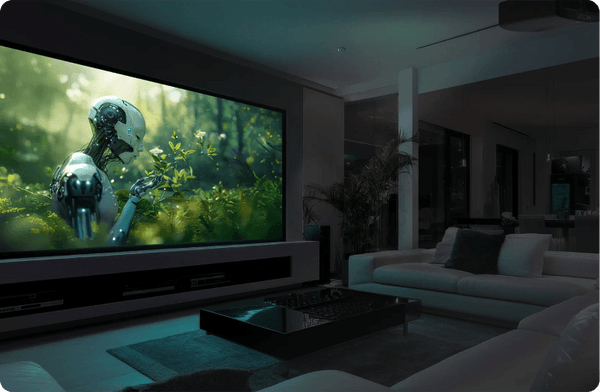
Rockstar’s footage makes a particularly good case for a projector. Look at the reflections around Vice City at night, the detail in the palms and buildings, and the view over the Leonida Keys. Put the horizon across a 120-inch screen and flying starts to feel like sitting in a simulator. The same thing happens behind the wheel. A windshield’s worth of picture gives your eyes more to work with as you judge a bend, notice cross traffic or look for an opening between two cars.
Rockstar lists a midnight local launch on November 19, 2026, for PS5 and Xbox Series X|S. In its November 10 update, Rockstar said it is targeting 30 frames per second on consoles. The game carries the PS5 Pro Enhanced label, and Rockstar confirmed PSSR upscaling and PS5 Pro-exclusive ray-traced shadows. PlayStation says the Extended Look was captured from in-game footage on PS5. I’d shop for a sharp, responsive 4K/60 HDMI picture for launch. That’s the signal the projector receives, and the game’s internal rendering resolution and frame rate can differ.
The best GTA VI projectors at a glance
Pick the room first. In a dark theater, I’d pay for contrast and a good lens. In a living room, I’d put money into the screen and control where the light lands. Outside, I’d take a bright $1,559 projector and a tight screen over a pricier projector fighting the sun. Every model below is listed at ProjectorScreen.com. I checked prices and shipping on November 14, 2026. ProjectorScreen listed seven of the ten in stock: the JVC, the Sony, the Hisense XR10, C3 Ultra Max and PX4 Pro, the Epson Grand Plus and the Nebula X1. The Epson LS6000, XGIMI HORIZON 20 and HORIZON 30 Pro each showed two to three weeks before dispatch. Several of these were sale prices, so the price gaps I mention can change. Check the product page for current pricing and confirm delivery if you’re buying for launch night.
Scroll the table to see latency and screen pairings.
| Best fit | Projector | 4K display and input | Latency evidence | Screen type |
|---|---|---|---|---|
| Dedicated theater |
JVC DLA-NZ800 $18,999.95 |
Native 4K panels, 4K/120 input | ALLM with firmware v2.00 or later | Neutral fixed frame |
| Premium home theater |
Sony BRAVIA Projector 7 $7,998 |
Native UHD display at up to 120 Hz | Under 21 ms claimed at 4K/60 (Sony spec) | Neutral fixed frame |
| Value for a permanent setup |
Epson Home Cinema LS6000 $2,199.99 |
Pixel-shifted 4K, up to 4K/120 input | Under 20 ms claimed (Epson gaming spec) | Fixed frame for controlled light |
| Large image for a multipurpose room |
Hisense XR10 $4,997.97 |
Pixel-shifted 4K/60, high refresh at 1080p | 17 ms measured at 4K/60 with DLP Turbo (our review) | Matte fixed frame or compatible standard-throw ALR |
| Flexible shelf or tabletop setup |
Hisense C3 Ultra Max $3,797.97 |
Pixel-shifted 4K/60, high refresh at 1080p | ALLM (Hisense). The 1 ms claim is for 1080p/240. | Matte fixed frame |
| Living-room triple laser |
Hisense PX4 Pro $3,997.97 |
Pixel-shifted 4K/60 at full resolution | ALLM (Hisense). The 1 ms claim is for the 240 Hz mode. | UST-specific ALR |
| Living-room UST with 4K/120 input |
Epson Lifestudio Grand Plus $3,799.99 |
Pixel-shifted 4K, up to 4K/120 input on HDMI 1 or 2 | 20.2 ms net measured at 4K/60 in our review | UST-specific ALR |
| Backyard value |
XGIMI HORIZON 20 $1,559 |
Pixel-shifted 4K/60 display, faster modes at 1080p | 3 ms claimed at 4K/60 (XGIMI Game-mode spec) | Folding outdoor screen |
| New 4K/120 triple laser |
XGIMI HORIZON 30 Pro $2,099 |
Pixel-shifted 4K/120 display (XGIMI spec) | 3 ms at 4K/60 and 1.9 ms at 4K/120 claimed (XGIMI Game-mode specs) | Fixed frame indoors, folding screen outdoors |
| Carry it between setups |
Soundcore Nebula X1 $2,299 |
Pixel-shifted 4K/60 | Game (Extreme) mode. No ProjectorScreen lag measurement. | Folding matte screen |
“Claimed” figures are manufacturer specs. “Measured” figures come from ProjectorScreen reviews. Compare lag figures at the same resolution, refresh rate and picture mode. Check where the tester placed the sensor and what the result includes.
The GTA VI spec I’d shop for first
Frame rate is how often the game makes a new image. HDMI refresh is how often the console sends a frame over HDMI, including repeated frames. Displayed refresh is how often the projector can update the image on screen. With a steady 30 fps in a 60 Hz signal, each game frame can stay on screen for two refreshes. Higher refresh can help other games. In Monster Hunter Wilds on PS5, Balanced mode targets 40 fps. At a steady 40 fps, each frame can stay on screen for three evenly spaced refreshes at 120 Hz.
For GTA VI’s 30 fps target, I’d prioritize a good 4K image and low input lag at 4K/60. Set the projector to its Game or Fast mode for that signal. Some models have a separate 1080p/120 mode that really is faster when the console and game can use it. Others accept 4K/120 and convert it on the way to the screen. Read the figures for the resolution and refresh you’ll actually play at. For scale, one 60 Hz refresh interval lasts 16.7 ms, and one at 120 Hz lasts 8.3 ms. Those intervals alone tell you little about the processing a projector adds.
ALLM stands for Auto Low Latency Mode. A compatible console can tell the projector to switch to its low-lag path automatically. A manual Game or Fast setting can do the same job on projectors that give you the choice. VRR, variable refresh rate, is separate. It lets a compatible source and display vary refresh within a supported range. Check that range at your intended resolution. A console menu that reports 120 Hz tells you what it’s sending. The projected image is a separate question.
My selection weighs 4K/60 response, contrast for night scenes, brightness at a sensible screen size, and whether the optics can put the image where you need it. I draw on ProjectorScreen reviews where we’ve tested the model, and I’ve labeled the manufacturer specs. My gaming impressions come from the earlier titles named below.
Dedicated AV room · JVC DLA-NZ800

Buy the NZ800 if you’ve already done the work of making the room dark and want that effort to show. Its three native 4,096 × 2,160 D-ILA panels, rated 2,700 lumens and 4K/120 input give it the hardware for a proper theater that also happens to play games. The draw for GTA is what happens after sundown. Headlights, wet pavement and storefronts get more separation from the dark around them. Our NZ800 review measured 40,900:1 sequential contrast one meter from the lens in High Bright mode with the iris open, and praised its black level and shadow detail. ProjectorScreen’s JVC DLA-NZ800 review
The firmware matters. JVC added ALLM in v2.00 for the NZ800, NZ900 and their RS3200/RS4200 siblings. Check that the installed version is v2.00 or later and use JVC’s update for your exact model. If the console sends HDR10 and triggers ALLM, look for HDR10 (LL) in the projector’s picture mode. With ALLM active, Frame Adapt HDR, Laser Dynamic Control and Clear Motion Drive are disabled. That makes the console’s HDR adjustment worth revisiting if you calibrated it in a different picture mode. For GTA VI I’d start in the low-lag path. For other titles that use 4K/120, JVC specifies HDMI EDID mode A. If you switch back to a movie, check that your preferred HDR processing has returned. Our review predates the ALLM update.
Screen pairing. In a room with dark surfaces and controlled light, use a neutral, 16:9 fixed frame such as the 1.0-gain Stewart StudioTek 100. A 120-inch diagonal is a practical starting point. Account for the loss in light if you move to an acoustically transparent screen with speakers behind it. Shop Stewart StudioTek 100
Premium home theater gaming · Sony BRAVIA Projector 7

The VPL-XW5100ES is my pick for someone who wants a native UHD projector for console gaming and movies without moving into the NZ800’s price bracket. Its three SXRD panels are 3,840 × 2,160, and the projector can display 4K at 120 Hz with a compatible source. Sony specifies input lag under 21 ms at 4K/60 and under 12 ms at 4K/120, and supports ALLM. The 60 Hz number is the one I’d use for the GTA VI buying decision. The faster mode is useful for other supported games.
Our review measured 14,812:1 native contrast on screen after calibration. Between that and the sharp native image, this is a good fit for people who want to see details in both the shaded side of a street and the bright stuff across it. Its 2,200-lumen rating makes a light-controlled room and a sensible screen size worthwhile. Zoom, focus and lens shift are manual, so settle the mounting location before you close up the ceiling. ProjectorScreen’s BRAVIA Projector 7 review
Screen pairing. A 100- to 120-inch, 16:9 matte fixed frame suits a dark room. I’d keep the screen around unity gain for a wide sofa and go larger only after checking throw, calibrated light output and seating. Shop the 120-inch Stewart StudioTek 100
Best value for a permanent setup · Epson Home Cinema LS6000

Here’s where I’d start if you have around $2,200 for the projector, a place to mount it and a family room that also does duty for sports. Epson rates the LS6000 at 3,400 lumens for white brightness under ISO and 3,400 lumens for color brightness under IDMS. It uses 3LCD and pixel shifting for its 4K image, with optical zoom and lens shift to get the image on the screen. The 3LCD design also avoids the sequential-color rainbow flashes some people see with single-chip DLP. Epson specifies HDMI input up to 4K/120, ALLM and input lag below 20 ms in its gaming specs. I didn’t independently measure the lag or verify the high-refresh claim in my review. My LS6000 review
I played an earlier Grand Theft Auto game, Gran Turismo and pinball on PS5 Pro for that review. “Bright tracks and luminous pinball tables look fantastic” was how I put it. The caveat showed up in darker scenes, where the black floor was visibly elevated. I measured 406:1 to 451:1 sequential contrast in Natural mode. If most of your time in Leonida is going to be spent under clear skies or with the room lights partly on, the Epson’s brightness and price make sense. For a dedicated dark theater built around nighttime detail, this is where the Sony or JVC earns the upgrade.
Screen pairing. Where you can draw the shades, use a 16:9 fixed-frame screen such as the 128-inch Elite Sable Frame 2, if your room can accommodate it. If stray light is unavoidable, ask about a standard-throw ALR material that matches your throw and seating. UST screen material is designed for a different projection angle. Shop Elite Sable Frame 2
Best for a large, bright image · Hisense XR10

The XR10 is the one I’d buy if I wanted to see Vice City at 150 inches in a multipurpose room. At $4,997.97, it costs $1,200 more than the C3 Ultra Max. The reasons to pay extra are light output and a longer throw. Hisense rates it at 6,000 ANSI lumens, and I measured about 4,800 lumens in HDR Filmmaker on a full-white test pattern. The 0.84–2.0:1 throw range, motorized zoom and lens shift give you room to place the projector. For a 150-inch 16:9 image, the lens can sit roughly 9.2 to 21.8 feet from the screen. The adjustable iris lets you trade some of that light for a lower black floor when you dim the room. My Hisense XR10 review
Play GTA VI at 4K/60. I measured 34 ms at 4K/60 in Games mode and 17 ms with DLP Turbo enabled. I’d try Turbo if the steering feels slow, then compare color with it on and off. High refresh on the XR10 is a separate 1080p mode. My testing and picture-mode notes
Screen pairing. Start with a 16:9 matte-white fixed frame if you can control room light. If stray light is the problem, consider a standard-throw ALR screen like the 0.6-gain Spectra Shadowscape. Check the material’s minimum throw and seating angles before choosing where to mount the XR10, especially if you plan to use the wide end of the lens. Shop Spectra Projection Shadowscape
Best all-in-one for a flexible game room · Hisense C3 Ultra Max

The C3 Ultra Max costs $3,797.97, and I’d pick it when the room has to do double duty and the projector might end up on a shelf one night and on a table the next. Hisense rates it at 5,000 ANSI lumens. It has a 2× optical zoom, motorized lens shift, an adjustable iris and a 56-watt, 2.1-channel Devialet-tuned sound system. Use the zoom and shift to fill the screen without digital keystone. Its 0.85–1.7:1 throw puts the lens roughly 7.4 to 14.8 feet from a 120-inch 16:9 screen. It weighs 25.8 pounds, so I’d set it on a sturdy surface.
The standard C3 Ultra was $2,797.97 when I checked. The Max’s $1,000 premium buys an extra 1,000 rated ANSI lumens, a wider zoom range and more lens shift. I’d spend it if the Ultra can’t fill the screen from the shelf I have, or if I need more light for a large image. The two models share the same listed gaming features. Our Hisense C3 series comparison
Start with 4K/60 and Game mode. Hisense supports ALLM and lists a 48–240 Hz VRR range at 1080p. Its advertised 1 ms input lag is for the separate 1080p/240 mode.
Screen pairing. Start with a matte fixed frame of about 120 inches, such as the 115-inch Elite Sable Frame 2. If you mainly play after the room is dark, close the iris a step at a time and stop when the black level improves without taking too much brightness out of the highlights. Shop the 115-inch Elite Sable Frame 2
Best living-room triple-laser UST · Hisense PX4 Pro

For the living room where a ceiling mount is out of the question, I’d happily put a PX4 Pro on a low console. It’s a 3,500-ANSI-lumen-rated RGB triple-laser DLP with pixel-shifted 4K, a sharp UST lens and an adjustable iris. Its accurate picture modes had enough light for a 100- to 120-inch image in my review. That’s a good size for showing off the saturated neon and retaining enough brightness for daytime scenes. The iris gives you a useful adjustment when you close the shades at night. My PX4 Pro review
Use 4K/60 for GTA VI. The PX4 Pro accepted 4K/120 from Gran Turismo on my PS5 Pro. On that setup, the projected image stayed at 60 Hz and visibly lost detail. Hisense confirmed that its 4K/120 input uses a reduced-resolution path. I later spent several hours playing GTA Online on the same system and preferred the crisp, full-resolution 4K/60 presentation. The projector’s 240 Hz mode runs at 1080p, above the consoles’ 120 Hz output limit.
Start in Theater, then turn on Low Latency. I preferred HDR Theater with Low Latency enabled. In my SDR comparison, the factory Game preset was only about 2% brighter than Theater Night and pushed the picture noticeably cooler. For a dim room with a 100- to 120-inch screen, try the fixed iris at Manual 3 with Brightness Enhancer off. On my review unit in HDR Theater, that kept 83% of the open-iris light and raised measured sequential contrast from 3,021:1 to 4,144:1. Open the iris again if room light starts to flatten the picture. My picture mode and iris measurements

Screen pairing. For a living room with overhead light, start with a 100- or 120-inch UST-specific ambient-light-rejecting screen such as the Spectra Vantage. A lenticular screen like this is a good fit for a wide sofa and overhead lighting. If side light is the bigger problem, audition a Fresnel UST screen from the end seats as well as the center. It can reject light from more directions, with a narrower viewing cone. Measure the cabinet height, wall clearance and screen bottom together before you buy. ProjectorScreen’s UST screen guide · Shop the 120-inch Spectra Vantage UST ALR
Best living-room UST with 4K/120 input · Epson Lifestudio Grand Plus

The LS970B Grand Plus makes a strong case if you share a living room with someone who sees DLP rainbows or you play other games that can use 4K/120. The Grand Plus was also free of visible laser speckle in my tests. The 3LCD Epson accepts 4K/120 and uses pixel shifting for an image Epson rates at 8.29 million on-screen pixel positions. Epson rates it for 4,000 lumens of white brightness under ISO and 4,000 lumens of color brightness under IDMS. Its short 0.16:1 throw ratio is particularly handy when the furniture has to stay close to the wall. You still need a flat screen and careful alignment. My Epson Grand Plus review
In my review I measured about 20.2 ms net at 4K/60 and 16.5 ms net at 1080p/120. “Forza Horizon 5 at 4K/60 on Xbox Series X was excellent,” and Dirt 5 at 4K/120 showed what a game with an actual high-frame-rate mode could do.
Use HDMI 1 or 2 for 4K/120. HDMI 3 tops out at 4K/60. I’d put the console on HDMI 1 if I were using HDMI 2 for a soundbar over eARC. Leave ALLM on with a compatible console. To select Game Mode yourself, turn off both ALLM and Frame Interpolation so the manual control appears.
Screen pairing. Try a 120-inch UST ALR fixed frame and check the seating angle. The Grand Plus has enough light for a good-sized image, but direct sun on the screen will still wash it out. Shop the Spectra Vantage
Best value for the backyard · XGIMI HORIZON 20

The HORIZON 20 makes it easy to take a 4K picture out to the patio without committing to a permanent rig. It’s rated at 3,200 ISO lumens, weighs about 10.6 pounds and has two built-in 12-watt speakers, optical zoom and lens shift. On a 120-inch 16:9 screen, its 1.2–1.5:1 throw ratio puts the lens roughly 10½ to 13 feet from the screen. Check that you have that run before buying. If a pool or patio door gets in the way, go smaller or consider the shorter-throw Nebula below.
Run 4K/60 in Game mode and physically square the projector to the screen so you can leave digital keystone off. XGIMI lists 3 ms at 4K/60 in Game mode with auto keystone off. I’d use 4K/60 for the sharpest picture and 1080p for higher refresh rates. XGIMI’s advertised 1 ms figure is for 1080p/240, above the PS5 and Xbox Series X|S output limit of 120 Hz.
Screen pairing. Use a tensioned 100- to 120-inch 16:9 outdoor screen such as the 110-inch Elite Yard Master 2. Set up in shade, play after dusk, keep nearby fixtures off the screen and secure the frame. On a big outdoor image, darkness buys more usable contrast than another tier of projector. If you’re tempted by a 200-inch screen, it spreads the same light over about 2.8 times the area of a 120-inch screen. Check brightness in the Game mode you’ll actually use before planning around that size. ProjectorScreen’s outdoor setup guide · Shop the 110-inch Elite Yard Master 2
New triple-laser DLP to watch · XGIMI HORIZON 30 Pro

The 30 Pro is the one to look at if you want 4K/120 for the rest of your library and like the idea of spending closer to lifestyle-projector money. XGIMI specifies displayed pixel-shifted 4K at 120 Hz from a compatible HDMI 2.1 source, 4,800 ISO lumens, a dual iris, optical lens shift and ALLM. That explicit displayed-refresh specification is the change to look for when comparing new triple-laser DLPs with older models that accept the signal and convert it.
XGIMI claims 3 ms at 4K/60 and 1.9 ms at 4K/120 in Game mode with auto keystone off. Those are manufacturer figures for a new model. The case for it is the combination of the display mode, brightness and optical adjustments. For GTA VI, I’d pocket the $540 difference and buy the HORIZON 20. ProjectorScreen listed two to three weeks before dispatch for both XGIMIs on November 14, so I’d only plan on one for launch night if I already had it or confirmed delivery.
Screen pairing. Indoors, I’d start with a matte fixed frame such as the 128-inch Elite Sable Frame 2 if your room has the space. I’d use the Yard Master 2 on the patio. Use the lens shift and zoom first, with Game mode as your final check. Shop Elite Sable Frame 2 · Shop Elite Yard Master 2
Best portable theater · Soundcore Nebula X1

If the projector is going back in the closet, up to the roof deck or along to a rental house, the X1 makes a good one-box setup. Its carry handle, built-in 40-watt audio, motorized optical zoom with a 0.9–1.5:1 throw ratio and rated 3,500 ANSI lumens make it practical to move a genuinely large picture. At 13.7 pounds it’s closer to carrying a small piece of luggage than packing a pocket projector. I’ve used the X1 outdoors, where its automation helped it move between spaces.
For GTA VI the setting to remember is Game (Extreme), the faster of the X1’s two Game modes. Extreme disables keystone, so position the X1 square to the screen. With a 100-inch screen, allow roughly 6½ to 11 feet from lens to screen. Bring the X1’s AC adapter, the console and an HDMI cable. Away from an outlet, size any AC power station for the combined load and runtime of the console, projector and any extra audio gear.
Screen pairing. A folding matte screen gives you a predictable surface in a guest room or in the yard. Start at 100 inches if you frequently set up in tight spaces. I’d choose 110 to 120 inches for a roomy patio. Shop the Elite Yard Master 2
Size the screen before you buy the projector
Start at 16:9. At 12 feet, a 120-inch 16:9 screen spans about 40 degrees horizontally. That’s a useful starting point for a driving game where I want the road to fill my view and still be able to glance down at the minimap. If you find yourself hunting the corners for HUD information, move back or reduce the image. A 150-inch image has about 56% more area than a 120-inch image, so the same light output produces only about 64% of the screen brightness, all else equal. ProjectorScreen’s size and viewing-distance calculators
Match the screen to the light and the throw. Choose matte and neutral for a controlled theater. A flat matte screen can work with a UST in a dark room. If you need to reject room light, choose an ALR material made for UST. Leave room to position the cabinet. For a standard-throw projector in a multipurpose room, choose an ALR screen only after checking the lens position, minimum throw ratio, seating angles and where the room light comes from. Outdoors, start with a taut portable screen after dusk. Outdoor projector and screen guide
Set up your console for launch night
- Make room for the download. Preloading is open for digital preorders. If you bought the code-in-box edition, you can preload once you receive and redeem the code. Rockstar says to set aside up to 212 GB of free space, depending on your console.
- Connect the console directly for the first test. Use the right HDMI input, enable its enhanced signal mode if required, then check the console and projector signal menus. If you add an AVR, switch or wall run, confirm the whole chain still passes the resolution, HDR and refresh you selected.
- Find the low-lag mode. Check that ALLM engaged, or select Game, Fast or Extreme as appropriate. Turn off frame interpolation and align the picture with placement, zoom and lens shift where available. Digital geometry correction may be unavailable in the fastest mode or add lag.
- Adjust HDR in the mode you’ll use. Run the console’s HDR setup after you select the projector mode, screen size and light level. Once GTA VI is running, check a bright scene and a dark one and use the game’s own HDR controls if available. If your room floods the screen with light, deal with the light before you raise the shadow controls.
- Check the signal with the game running. On PS5, go to Settings → Screen and Video → Video Output to see the current signal and supported modes. On Xbox Series X|S, go to Settings → General → TV & display options → 4K TV details. Then check the projector’s info screen. Start with a 4K/60 signal and make sure your projector stays in its low-lag mode when the game switches to HDR.
If I were setting up for launch in a living room, I’d put the PX4 Pro on a 120-inch UST screen and run 4K/60. For a bigger image in a room that also sees daytime use, I’d buy the XR10. If I needed a 120-inch image from a tricky shelf and wanted sound built in, I’d choose the C3 Ultra Max. If I had a dark theater and movies were just as important as GTA, I’d choose the Sony or, with the room and budget to make the most of it, the JVC. For the patio, I’d buy the HORIZON 20 and a folding screen if I could wait for shipping. If I needed a portable or patio projector by November 19, I’d check delivery on the Nebula X1, which ProjectorScreen listed in stock on November 14.
Need help checking a throw distance, cabinet height or screen material? Talk to a ProjectorScreen specialist or call 888-392-4814.


