


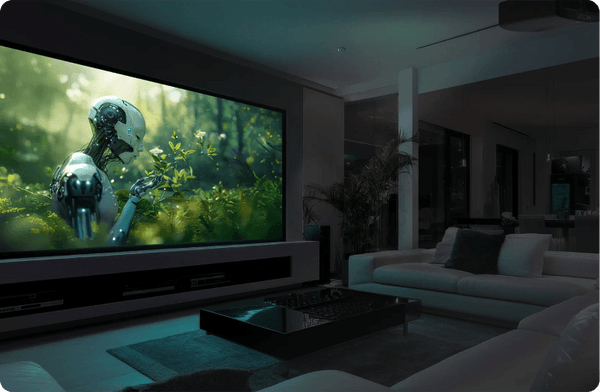
JVC DLA-NZ500 vs DLA-NZ700: Brightness and Wide-Gamut Cinema Filter Compared

Turn down every light in a dark-walled home theater, cue up the green cave light in It Chapter Two or the night flares in 1917 on a 120-inch screen, and the $2,000 question between the JVC DLA-NZ500 ($5,999.95, currently $1,000 off its $6,999.95 MSRP) and JVC DLA-NZ700 ($7,999.95, currently $2,000 off its $9,999.95 MSRP) comes into sharp focus. Both projectors share JVC's redesigned compact chassis, three 0.69-inch Gen 3 native 4K D-ILA panels, a motorized 80 mm 1.6x lens, and Gen 2 Frame Adapt HDR tone mapping. Stepping up to the DLA-NZ700 buys three concrete optical upgrades: rated brightness climbs from 2,000 to 2,300 lumens (measuring 20% to 25% brighter unfiltered on our test bench), native contrast doubles from 40,000:1 to 80,000:1, and a motorized Cinema Filter slides into the light path on demand to expand HDR color coverage to 98% of DCI-P3.
Projector Overview and Theater Fit
Both models ship on ProjectorScreen.com in matte-black theater finishes engineered for ceiling mounts or rear shelves fed by an AV receiver or surround processor. Because they share identical outer dimensions, throw ratios, and dual 32 Gbps HDMI boards, deciding between them comes down to your screen area, fabric gain, and appetite for full DCI-P3 saturation.

JVC DLA-NZ500
Brings three Gen 3 native 4K D-ILA chips, 40,000:1 native contrast, filterless 93% DCI-P3 color, and Gen 2 Frame Adapt HDR to dedicated dark rooms at JVC's most accessible laser price.
- Imaging Engine
- 3 x 0.69" Gen 3 Native 4K D-ILA
- Brightness
- 2,000 lm Rated (1,715 lm 6500K)
- Native Contrast
- 40,000:1 Native / Infinite Dyn.
- Wide Gamut
- Filterless (93% DCI-P3 u'v')
- Lens & Shift
- 1.6x 80 mm, ±70% V / ±28% H

JVC DLA-NZ700
Steps up to higher-binned 80,000:1 native contrast optics, 2,300 rated lumens (2,050 calibrated D65 lumens unfiltered), and a selectable Cinema Filter reaching 98% DCI-P3 coverage.
- Imaging Engine
- 3 x 0.69" Gen 3 Native 4K D-ILA
- Brightness
- 2,300 lm Rated (2,050 lm D65)
- Native Contrast
- 80,000:1 Native / Infinite Dyn.
- Wide Gamut
- Cinema Filter (98% DCI-P3 u'v')
- Lens & Shift
- 1.6x 80 mm, ±70% V / ±28% H
Where Each JVC Laser Projector Fits Best
When I calibrate D-ILA projectors on client screens, screen surface area and gain dictate how far your lumens stretch long before fine menu tweaks come into play. Because both models use the exact same cabinet and lens geometry, your screen size, acoustic weave loss, and budget allocation tell you immediately where that $2,000 spread works hardest.
Choose the JVC DLA-NZ500 for Dedicated Dark Rooms and Maximum Value
- 100-inch to 125-inch unity-gain screens in light-sealed rooms: 1,715 lumens at 6500K comfortably drives reference 100-nit SDR and 200-nit+ HDR windows on standard 1.0-gain white vinyl without engaging a light-robbing filter.
- Balanced filterless wide color right out of the light engine: Native diode-phosphor tuning reaches 93% of DCI-P3 (u'v') while keeping every available lumen on screen.
- Putting $2,000 toward a reference screen or subwoofer: Redirecting the price difference into dark room treatments, a tensioned screen, or bass management yields huge gains in perceived contrast.
Choose the JVC DLA-NZ700 for Bigger Screens, Higher Contrast, and Wide-Gamut HDR
-
130-inch to 145-inch screens or 0.7 to 0.9 gain acoustically transparent weaves: Running unfiltered in
BT.2020(Normal)delivers 2,050 calibrated D65 lumens, giving you 20% to 25% more real-world foot-lamberts than the NZ500 to compensate for speaker-cloth light loss. -
98% DCI-P3 saturation on moderate-sized or positive-gain screens: On 100-inch to 120-inch 1.0-to-1.3-gain screens, engaging
BT.2020(Wide)slides the motorized Cinema Filter in for deep crimson, emerald, and cyan HDR primaries at 1,630 calibrated D65 lumens. - Maximum dark-scene depth in batcave theaters: Tighter optical polarization binning doubles rated native contrast to 80,000:1 while holding an ink-black 0.0026-nit floor on our bench.
Full Specification Comparison
Every figure below is verified directly against JVCKENWOOD's official engineering manual, live ProjectorScreen.com product listings, and Alan Young's individual bench evaluations.
| Specification | JVC DLA-NZ500 (RS1200) | JVC DLA-NZ700 (RS2200) |
|---|---|---|
| Live Price & MSRP | $5,999.95 ($1,000 off $6,999.95 MSRP; $2,000 less than NZ700) | $7,999.95 ($2,000 off $9,999.95 MSRP) |
| Availability, SKU & Finish | Leaves Warehouse within 2-3 Weeks; SKU JVC-DLA-NZ500; Black chassis finish |
Leaves Warehouse within 2-3 Weeks; SKU JVC-DLA-NZ700; Black chassis finish |
| Reference & Refurbished Options | Optically identical to Procision DLA-RS1200 ($6,999.95); Manufacturer Refurbished NZ500 ($5,599.95) | Optically identical to Procision DLA-RS2200; Manufacturer Refurbished NZ700 ($7,199.95)
|
| Imaging Panels & Convergence | Three 0.69" Gen 3 Native 4K D-ILA devices; whole-screen and 10 x 10 zone Pixel Adjust | Three 0.69" Gen 3 Native 4K D-ILA devices; whole-screen and 10 x 10 zone Pixel Adjust |
| Displayed Resolution | 4096 x 2160 native 17:9 (8.85M pixels) and 3840 x 2160 16:9 UHD (8.29M pixels) | 4096 x 2160 native 17:9 (8.85M pixels) and 3840 x 2160 16:9 UHD (8.29M pixels) |
| Laser Light Engine | BLU-Escent blue laser diode phosphor (~20,000-hour life; 101-step 0 to 100 LD Power slider) | Higher-output BLU-Escent blue laser diode phosphor (~20,000-hour life; 101-step 0 to 100 LD Power slider) |
| Rated & Bench Brightness | 2,000 lm rated (1,960 lm High Bright; 1,715 lm 6500K in Alan Young's bench test) | 2,300 lm rated (2,410 lm Natural High Bright; 2,050 lm Natural D65 unfiltered; 1,630 lm D65 with Cinema Filter) |
| Contrast & Aperture | 40,000:1 native / Infinite:1 dynamic (16-step -15 to 0 lens aperture; Dynamic CTRL Off, Low, High, Balanced) | 80,000:1 native / Infinite:1 dynamic (16-step -15 to 0 lens aperture; Dynamic CTRL Off, Low, High, Balanced) |
| Color Gamut & Cinema Filter | Filterless optical path (BT.2020 profile; 93% DCI-P3 and 70% BT.2020 measured in CIE 1976 u'v') |
Motorized selectable Cinema Filter: BT.2020(Wide) reaches 98% DCI-P3 u'v' (~96% xy; ~94% at 10% stimulus); BT.2020(Normal) unfiltered reaches 89% u'v' (~84% xy) |
| HDR & Picture Modes | HDR10, HDR10+, HLG, FILMMAKER MODE; Gen 2 Frame Adapt HDR (Frame by Frame & Scene by Scene with MaxCLL/DML), HDR Quantizer, Deep Black, SDR Vivid | HDR10, HDR10+, HLG, FILMMAKER MODE; Gen 2 Frame Adapt HDR (Frame by Frame & Scene by Scene with MaxCLL/DML), HDR Quantizer, Deep Black, SDR Vivid |
| Lens & Motorized Shift | 80 mm (3.15"), 15-element, 11-group 1.6x motorized zoom/focus 4K lens; ±70% V / ±28% H shift (16:9) | 80 mm (3.15"), 15-element, 11-group 1.6x motorized zoom/focus 4K lens; ±70% V / ±28% H shift (16:9) |
| 16:9 Throw Ratio & Distances | 1.34–2.14:1 (100": 9.78–15.72 ft; 120": 11.75–18.90 ft; 150": 14.73–23.65 ft; 60"–200" range) | 1.34–2.14:1 (100": 9.78–15.72 ft; 120": 11.75–18.90 ft; 150": 14.73–23.65 ft; 60"–200" range) |
| 17:9 Full-Panel Throw | 1.26–2.01:1 (100": 9.28–14.96 ft; 120": 11.19–17.98 ft; 150": 14.01–22.51 ft) | 1.26–2.01:1 (100": 9.28–14.96 ft; 120": 11.19–17.98 ft; 150": 14.01–22.51 ft) |
| Installation Memories | 5 named Installation Modes storing zoom, focus, shift, pixel adjust, masking, aspect, and 3-digit Screen Setting RGB code | 5 named Installation Modes storing zoom, focus, shift, pixel adjust, masking, aspect, and 3-digit Screen Setting RGB code |
| HDMI, Gaming & Motion | 2 x 32 Gbps HDMI (HDCP 2.3, up to 4K60); ~34 ms 60Hz Low Latency mode; Clear Motion Drive 60Hz BFI (Off, Low, High) | 2 x 32 Gbps HDMI (HDCP 2.3, up to 4K60); ~34 ms 60Hz Low Latency mode; Clear Motion Drive 60Hz BFI (Off, Low, High) |
| Control, AutoCal & Firmware | External AVR system design; RJ-45 LAN (IP control & JVC AutoCal), USB-A backup/updates (incl. April 27, 2026 FW v1.03 fan curve update), front/rear IR | External AVR system design; RJ-45 LAN (IP control & JVC AutoCal), USB-A backup/updates (incl. April 27, 2026 FW v1.03 fan curve update), front/rear IR |
| Dimensions, Weight & Airflow | 17.72" W x 7.13" H x 18.86" D (450 x 181 x 479 mm incl. feet); 32.2 lb (14.6 kg); 280W; 23 dB min; front intake / rear exhaust | 17.72" W x 7.13" H x 18.86" D (450 x 181 x 479 mm incl. feet); 32.6 lb (14.8 kg); 280W; 24 dB min; front intake / rear exhaust |
| Mounting, Box & Warranty | 4 x M5 bottom mount points (mount sold separately); backlit RM-MH27 remote, lens cover, ~6.5 ft power cord; 3-Year JVC Limited Parts & Labor Warranty |
4 x M5 bottom mount points (mount sold separately); backlit RM-MH27 remote, lens cover, ~6.5 ft power cord; 3-Year JVC Limited Parts & Labor Warranty |
Brightness, Native Contrast, and the Motorized Cinema Filter
On paper, jumping from 2,000 to 2,300 rated lumens looks like a modest 15% bump. On the calibration bench, the optical relationship between these two BLU-Escent engines is much more interesting because JVC tunes their phosphor wheels and color paths differently. Because the DLA-NZ500 lacks a physical color filter, JVC balances its native diode-phosphor spectrum to hit 93% of DCI-P3 (and 70% of BT.2020 in CIE 1976 u'v') right out of the open light path, yielding 1,960 peak lumens in High Bright and 1,715 lumens at 6500K.
For the DLA-NZ700, JVC installs a higher-output laser assembly and pairs it with a motorized Cinema Filter that clicks into or out of the light path depending on your Color Profile selection. Leave the filter disengaged in BT.2020(Normal), and the NZ700 prioritizes raw optical throughput: it hit 2,410 lumens in Natural High Bright and 2,050 calibrated D65 lumens in our lab test, giving you roughly 20% to 25% more real-world calibrated light than the NZ500 while covering 89% of DCI-P3 in u'v' (~84% in CIE 1931 xy at full stimulus, tapering to ~81% at 10% stimulus). Switch the profile to BT.2020(Wide), and the Cinema Filter slides into place, trimming calibrated D65 output by about 20% to 1,630 lumens while expanding coverage to 98% of DCI-P3 in u'v' (~96% xy at full stimulus, holding a remarkably steady ~94% even down at 10% dark-scene stimulus).
That dual-mode flexibility is why the NZ700 adapts to such a wide range of theaters. In films graded deep into DCI-P3 and BT.2020 like Inside Out, the stove-fire interior of 1917, or the emerald cavern finale of It Chapter Two, engaging the NZ700's Cinema Filter preserves rich low-luminance color saturation where unfiltered phosphor engines start to desaturate. Conversely, on a 135-inch 0.8-gain woven acoustically transparent screen or high-APL titles like Dragon Ball Super: Super Hero, disengaging the filter hands you 2,050 calibrated lumens that keep highlights energetic. Meanwhile, the NZ500 sits right in a sweet middle ground for 100-inch to 125-inch dark rooms: 93% DCI-P3 without ever sacrificing lumens to a filter.
Native contrast follows JVC's classic optical binning hierarchy. Both projectors pair reflective D-ILA panels with a 16-step manual lens aperture (-15 to 0), a 101-step fine laser power slider (0 to 100), and four Dynamic CTRL laser dimming profiles (Off, Low, High, and Balanced). Tighter wire-grid polarization tolerances double the NZ700's rated native contrast from 40,000:1 to 80,000:1. In typical mid-zoom theater throws with moderate iris settings, both units routinely operate in the 30,000:1 to 50,000:1 native range, while stopping down the NZ700's iris pushed calibrated native contrast past 50,000:1 on our bench.
Gen 2 Frame Adapt HDR, Tone Mapping, and Picture Modes
Both projectors run identical video processing for HDR10, HDR10+, HLG, and FILMMAKER MODE. Focusing on open HDR10, HDR10+, and HLG metadata rather than Dolby Vision, JVC's internal Gen 2 Frame Adapt HDR engine eliminates the guesswork of watching 1,000-nit, 4,000-nit, and 10,000-nit UHD masters on a front-projection screen. Selecting Frame Adapt HDR 1 or 2 lets the processor inspect incoming video either Frame by Frame or Scene by Scene, factoring in both Maximum Content Light Level (MaxCLL) and Display Mastering Luminance (DML) metadata to map specular highlights smoothly without crushing shadow steps.
Two supporting tools refine that tone curve further: HDR Quantizer (offering Auto(Normal), Auto(Wide) for extra highlight punch, plus five manual steps) and JVC's new Deep Black tone control, which extends perceived contrast in near-black gradations without clipping dark textures in night scenes. Keep one menu quirk in mind if your Blu-ray player outputs HDR10+: JVC's HDR10+ mode locks the color profile to unfiltered BT.2020(Normal) and grays out calibration adjustments, so most enthusiasts and calibrators leave dynamic HDR10+ disabled on the player and let Frame Adapt HDR drive the NZ700's wide Cinema Filter instead. For daytime sports, 2D animation, and colorful CG content, both models also add a dedicated SDR Vivid mode alongside Natural and Filmmaker.
Shared 80 mm Motorized Optics, Lens Shift, and Throw Distances
Mechanically, the DLA-NZ500 and DLA-NZ700 use the exact same newly engineered 80 mm (3.15-inch), 15-element, 11-group 4K lens with 1.6x motorized zoom, motorized focus, and ±70% vertical / ±28% horizontal motorized lens shift (for 16:9 framing, tapering along an elliptical envelope when combining vertical and horizontal offsets). Despite moving from the 65 mm all-glass barrel of the older lamp-based DLA-NP5 to this larger-diameter 80 mm assembly, edge-to-edge sharpness across all three native 4096 x 2160 panels is crisp from center to corner, and JVC's coarse and fine 10 x 10 zone Pixel Adjust menu dials in subpixel RGB convergence cleanly.
When planning your mount location, watch out for a common JVC spec-sheet nuance. Because the native D-ILA chip measures 4096 x 2160 (a 17:9 aspect ratio), JVC's single-table retail Projection Distance Chart lists full-panel 17:9 widths (88.6 inches wide at a 100-inch diagonal; 106.3 inches wide at 120 inches), corresponding to a 1.26–2.01:1 throw ratio. On a standard 16:9 UHD home theater screen (3840 x 2160, which masks the outer 256 pixel columns to 87.2 inches wide at 100 inches and 104.6 inches wide at 120 inches), the effective throw ratio is 1.34–2.14:1, requiring roughly six to nine inches of extra throw distance at the wide end of the zoom.
Cinemascope 2.39:1 screen owners are well served on both models through 5 named Installation Modes. Each memory slot recalls motorized zoom, focus, shift, pixel convergence, aspect ratio, digital masking, and a 3-digit Screen Setting code from JVC's screen fabric lookup table to compensate for subtle RGB tint shifts across woven or high-gain materials.
Gaming Latency, Motion Control, and Compact Chassis Design
JVC builds both projectors strictly around dedicated cinema playback and external AV switching. Dual 32 Gbps HDMI ports (HDCP 2.3) accept signals up to 4K60, and enabling Low Latency mode drops 60Hz input lag to roughly 34 ms (just over two frames), which feels responsive for story-driven adventures, racing games, and RPGs at 4K60 while omitting 4K120, VRR, and 3D playback. If competitive sub-20 ms 4K120 console gaming, brighter multi-use room lighting, or a 2.1x long-throw zoom top your checklist around $6,000, see our Epson LS12000 vs JVC DLA-NZ500 comparison; within JVC's own lineup, 4K120 and 3D begin on the step-up 8K e-shift DLA-NZ800. For 24p film motion, both the NZ500 and NZ700 preserve authentic 24p cadence without motion-smoothing interpolation, offering optional Clear Motion Drive black-frame insertion (Low and High) for 60Hz content.
Physically, this generation marks JVC's smartest mechanical redesign in years. Measuring 17.72" W x 7.13" H x 18.86" D (450 x 181 x 479 mm including the four corner feet, correcting the transposed depth figure seen on some retail spec tables where the 3.15-inch lens diameter slipped into the depth column), the cabinet occupies 35% less volume than its previous DLA-NZ7 laser chassis and weighs 32.2 lb (NZ500) or 32.6 lb (NZ700). JVC also reversed its airflow path: cool air now enters through the front grille and warm exhaust exits out dual rear vents away from viewers, so leave generous rear breathing room on shelves and order a compatible ceiling mount for the four bottom M5 mounting points.
Day-to-day acoustics are impressively hushed, rated at 23 dB (NZ500) and 24 dB (NZ700) at minimum laser power, and JVC's April 27, 2026 Firmware v1.03 update (installed via the rear USB-A service port) further refined the cooling fan speed curve across mid-to-high laser steps. Because the minimalist housing omits chassis menu buttons, 12V triggers, eARC, and HDMI-CEC, plan on controlling power and presets with the compact backlit RM-MH27 remote (front and rear IR sensors) or over Ethernet via the RJ-45 LAN port, which also connects directly to JVC's free AutoCal software.
Alan Young Bench Measurements and Calibrated Accuracy
Both projectors were bench-tested on ProjectorScreen.com by calibrator and reviewer Alan Young in our JVC DLA-NZ500 full review (published December 3, 2024) and JVC DLA-NZ700 full review (published June 2, 2026) using a Colorimetry Research CR-250 spectroradiometer, CR-100 colorimeter, Murideo 6G generator, and Calman Ultimate. Keep test-room geometry in mind when comparing nit totals: Alan measured the NZ500 on a 100-inch 1.0-gain white screen from a 12-foot throw, whereas he tested the NZ700 on a 92-inch 1.3-gain white screen at mid-zoom.
On the 100-inch 1.0-gain screen, Alan's DLA-NZ500 hit 1,960 peak lumens in High Bright and 1,715 lumens at 6500K. Calibrated for reference SDR at 105 nits (LD Power 46, Aperture -12), it delivered a 0.003-nit black floor for 35,274:1 off-screen native contrast (33,153:1 on his multi-point grayscale chart), 2.399 gamma, an average grayscale DeltaE 2000 of 0.3, and a ColorChecker average of 0.4 (down from 2.5 out of the box). Switching to calibrated D65 HDR (Frame Adapt HDR 1, Frame by Frame, Auto Wide, LD Power 100, Aperture -2) put 225 nits on a standard window and 200 nits full-field.
On the 92-inch 1.3-gain screen, Alan's DLA-NZ700 exceeded JVC's spec with 2,410 lumens in Natural High Bright (1,965 lumens at full telephoto; 1,945 lumens with the Cinema Filter), 2,170 lumens in Natural 6500K, 2,050 lumens in calibrated Natural D65 unfiltered, 1,630 lumens in calibrated Natural D65 with the Cinema Filter engaged, and 1,510 lumens in out-of-the-box Filmmaker mode (LD Power 46). One notable sample finding: his NZ700's factory Natural SDR grayscale tracked overly blue and non-linear beyond what two-point user controls could straighten, requiring a custom 1D LUT upload to linearize D65 grayscale to a flat 2.4 gamma. Once that 1D LUT was loaded, SDR at LD Power 93 and Aperture -11 hit 135 nits over a 0.0026-nit black level (> 50,000:1 native contrast) with a ColorChecker SG average DeltaE 2000 of 0.67 (1.87 max), while D65 HDR (LD Power 93, Aperture -2) reached 225 nits on windows and 200 nits full-screen thanks to JVC's ~10% internal light recycling on smaller window sizes.


Alan Young Bench Review Scorecards
JVC DLA-NZ500 Bench Scores (December 3, 2024)
JVC DLA-NZ700 Bench Scores (June 2, 2026)
What Verified Buyers Experience in Real Home Theaters
Bench numbers show optical capability; customer theaters show how these two projectors live day to day across woven screens, tight throw distances, and AV receiver racks. Every review on both ProjectorScreen.com listings comes from a Stamped Verified Buyer.
JVC DLA-NZ500 Verified Buyer Feedback
4.75/5 across 4 Verified Buyer reviews
“The projector really shines with every possible source”
Chetan, May 13, 2025 · 5.0/5 · Verified Buyer
“The blacks are deep and the colors are amazing. ... It’s not the brightest but my HT has no light leakage so it’s perfectly fine. Also, I’ve never noticed the fan noise.”
Dewthedru, May 11, 2025 · 5.0/5 · Verified Buyer
“I can shelf mount the projector in the rear of my room and be able to adjust the projected picture with zero distortion to the screen surface.”
Aaron R., May 1, 2025 · 5.0/5 · Verified Buyer
“...the black levels are dark and the colors pop.”
Rodney R., March 3, 2025 · 4.0/5 · Verified Buyer
JVC DLA-NZ700 Verified Buyer Feedback
5.0/5 across 2 Verified Buyer reviews
“I was blown away at the color and black levels.”
Chris, March 20, 2026 · 5.0/5 · Verified Buyer
“This unit is better in every respect. I think we have found the point of diminishing returns in the projector world. For us it really doesn’t make sense to spend any more for something beyond what we are experiencing right here.”
Fiddler, May 11, 2025 · 5.0/5 · Verified Buyer
How to Choose Between the DLA-NZ500 and DLA-NZ700
Because neither projector cuts corners on native 4K D-ILA panel sharpness, motorized 80 mm optics, or Gen 2 Frame Adapt HDR, your screen math makes this call straightforward. Choose the JVC DLA-NZ500 ($5,999.95, or $5,599.95 Manufacturer Refurbished) if you are lighting up a 100-inch to 125-inch unity-gain screen in a dark room and want 93% DCI-P3 color and 40,000:1 native contrast while keeping $2,000 in your pocket for acoustic treatments, seating, or subwoofers. Step up to the JVC DLA-NZ700 ($7,999.95, or $7,199.95 Manufacturer Refurbished) if you are driving a 130-inch+ or low-gain acoustically transparent weave that benefits from 20% to 25% more calibrated D65 light unfiltered, or if you want 80,000:1 native contrast and the 98% DCI-P3 motorized Cinema Filter for reference HDR film nights.
Talk Through Your Screen Size and Gain with Our Projection Team
Want to verify exact foot-lamberts on your screen fabric or check lens shift clearance before mounting? Call our projection specialists at 888-392-4814, reach out through our ProjectorScreen.com contact page, or browse our full home theater projector collection for one-on-one room planning.
JVC DLA-NZ500 vs DLA-NZ700 FAQ
Is the $2,000 jump from the JVC DLA-NZ500 ($5,999.95) to the DLA-NZ700 ($7,999.95) worth it, and are refurbished units available?
Stepping up $2,000 to the DLA-NZ700 delivers three hardware upgrades inside the same compact body: 20% to 25% higher calibrated D65 light output when running unfiltered (2,050 vs 1,715 lumens on our bench), double the rated native contrast (80,000:1 vs 40,000:1), and the selectable Cinema Filter reaching 98% DCI-P3 coverage. Shoppers stretching their budget can also check availability on JVC Manufacturer Refurbished DLA-NZ500 ($5,599.95) and Manufacturer Refurbished DLA-NZ700 ($7,199.95) units.
How do the DLA-NZ500 and DLA-NZ700 compare to the Reference Series DLA-RS1200 and DLA-RS2200, and do they come in white?
JVC's Procision series and Reference Series share identical optical engines, specs, firmware, and 3-year warranties, differing only in subtle gold lens-ring trim and custom-integrator distribution channels. The DLA-NZ500 is optically identical to the JVC DLA-RS1200 ($6,999.95), and the DLA-NZ700 is optically identical to the DLA-RS2200. ProjectorScreen.com stocks both projectors exclusively in non-reflective matte Black theater housings.
Should I engage the DLA-NZ700's motorized Cinema Filter or leave it off for HDR movies?
Match the filter setting to your screen's surface area and gain. On 100-inch to 120-inch screens with 1.0 to 1.3 gain in a dark room, selecting BT.2020(Wide) engages the Cinema Filter for 98% DCI-P3 (u'v') saturation while still retaining 1,630 calibrated D65 lumens. On screens above 130 inches or acoustically transparent weaves (0.7 to 0.9 gain), switching to BT.2020(Normal) retracts the filter and puts all 2,050 calibrated D65 lumens on screen.
Why do JVC's brochure throw distances differ slightly from 16:9 screen calculators?
JVC's native D-ILA panels measure 4096 x 2160 (a wider 17:9 aspect ratio with a 1.26–2.01:1 throw ratio), which JVC uses on its single-sheet brochure distance table. Standard 16:9 UHD screens use the 3840 x 2160 portion of the chip at a 1.34–2.14:1 throw ratio, placing a 100-inch 16:9 screen at 9.78 to 15.72 feet, a 120-inch 16:9 screen at 11.75 to 18.90 feet, and a 150-inch 16:9 screen at 14.73 to 23.65 feet.
Can both projectors switch between 16:9 and 2.39:1 Cinemascope screens, and how does Screen Setting work?
Yes, both models store 5 named Installation Modes that recall motorized zoom, focus, lens shift, pixel convergence, aspect ratio, and digital masking so you can switch between 16:9 and 2.39:1 scope framing from the remote. Each Installation Mode also stores a 3-digit Screen Setting code from JVC's screen library to tailor RGB white balance to your screen fabric while Gen 2 Frame Adapt HDR dynamically reads MaxCLL and Display Mastering Luminance metadata.
How well do the DLA-NZ500 and DLA-NZ700 handle PS5, Xbox Series X, and PC gaming?
Both models feature dual 32 Gbps HDMI ports supporting up to 4K60, with Low Latency mode measuring roughly 34 ms at 60Hz for comfortable single-player, adventure, and RPG gaming on a cinema screen. Players who prioritize sub-20 ms 4K120 competitive play, HDMI-CEC/eARC convenience, or brighter ambient-light viewing around $6,000 should read our Epson LS12000 vs JVC DLA-NZ500 comparison, or step up to JVC's DLA-NZ800 for 4K120 D-ILA support.
What are the exact chassis dimensions, cooling clearances, and mounting requirements?
Both projectors measure 17.72" W x 7.13" H x 18.86" D (450 x 181 x 479 mm including feet; 32.2 lb on the NZ500 and 32.6 lb on the NZ700), representing a 35% volume reduction over JVC's previous DLA-NZ7 laser cabinet and correcting the transposed depth figure seen on some retail spec sheets. Cool air enters through the front intake and warm air exhausts out dual rear vents (refined further in JVC's April 27, 2026 Firmware v1.03 fan curve update), and ceiling mounts attach via four bottom M5 threaded points (mount sold separately).
Do I need professional calibration or a 1D LUT on the DLA-NZ500 and DLA-NZ700?
Both projectors produce deep blacks and well-behaved Gen 2 Frame Adapt HDR tone mapping out of the box, while calibration aligns D65 grayscale and color tracking to your specific room and screen. Alan Young calibrated the NZ500 to a 0.3 grayscale and 0.4 ColorChecker DeltaE 2000 using onboard controls, whereas his NZ700 review sample benefited from uploading a custom 1D LUT (supported via RJ-45 LAN and JVC AutoCal) to linearize an overly blue factory Natural preset to 2.4 gamma and a 0.67 ColorChecker SG average.
Shop Both Projectors, Refurbished Options, and Related Guides
- Shop JVC DLA-NZ500 Native 4K D-ILA Laser Projector ($5,999.95)
- Shop JVC DLA-NZ700 Native 4K D-ILA Laser Projector ($7,999.95)
- Shop JVC DLA-RS1200 Reference Series 4K Laser Projector ($6,999.95)
- Shop JVC DLA-NZ500 Manufacturer Refurbished ($5,599.95)
- Shop JVC DLA-NZ700 Manufacturer Refurbished ($7,199.95)
- Read Alan Young's Full JVC DLA-NZ500 Review (published December 3, 2024)
- Read Alan Young's Full JVC DLA-NZ700 Review (published June 2, 2026)
- Read Our Epson LS12000 vs JVC DLA-NZ500 Comparison
- Browse All Home Theater Projectors on ProjectorScreen.com
- Contact Our Projection Specialists (888-392-4814)


