


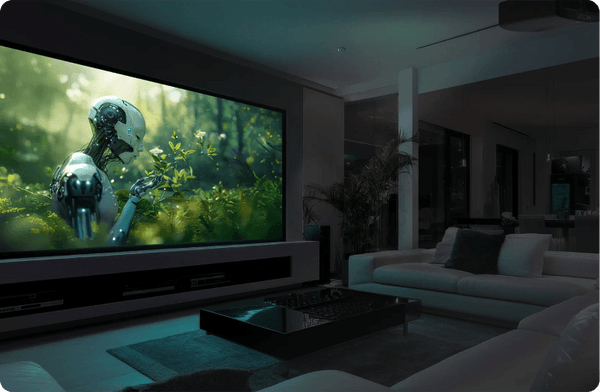
Hands-On at CINÈST’s NYC Press Event: Motorized UST Living Room Integration Meets 120-Inch Screen

Ultra-short-throw (UST) projectors promised to make big-screen living room integration effortless. Anyone who has actually aligned one knows the catch: because a UST lens sits inches from the wall and fires upward at a steep angle, even a small bump from a kid, a pet, or a duster can visibly knock the picture off the screen frame. Worse, landing the image at the right vertical height without resorting to digital geometric correction often means shimming a projector—or propping up an entire credenza.
At CINÈST’s New York City press event, I got an in-person look at how the brand tackles that problem in a bright, living-room-style Manhattan loft. Watch my hands-on video walkthrough below, or read on for the full report.
Furniture First: The POVISON Affiliation and Two Distinct Demos
CINÈST is a home theater furniture brand affiliated with modern furniture company POVISON, and the NYC showcase leaned directly into that design background. Rather than lining up cabinets under convention-hall fluorescents, the team staged a sunlit apartment living room outfitted with POVISON seating and accent tables.

To illustrate the difference system integration makes, CINÈST ran two separate rooms:
-
Open Tabletop Projection: A secondary room featuring a Hisense L9Q sitting openly atop a slatted wood media console, projecting directly onto an unframed white wall.
- Integrated Living Room Showcase: The primary space built around the motorized CINÈST Core E1 UST media console in Brown, housing a Hisense L9Q inside a recessed motorized bay, paired with a 120-inch Spectra Projection Phoenix motorized floor-rising UST ALR screen and flanked by a pair of passive KLH Model Seven floorstanding loudspeakers.

Walking between the two demos highlighted two immediate firsthand takeaways: how visually exposed (and bump-prone) a loose console-top UST projector is, and how much punchier the image looked on a directional lenticular UST ALR screen compared with a bare painted wall in a lit room.
Inside the CINÈST Core E1 Console
The centerpiece of the main room was the CINÈST Core E1 in a walnut-toned Brown finish. Part of the CINÈST Core Collection—which includes the Core A1 and Core E1 in 90.5-inch, 102.5-inch, and 118-inch widths (each 21 inches deep by 18 inches high, in Brown or Black, advertised starting at $2,999 for the 90.5-inch configuration), alongside a newly listed Core E3 preorder line with an integrated floor-rising screen slot.

Most motorized UST cabinets only slide a tray forward and backward along a single horizontal track. Moving a UST projector forward or backward changes both image size and vertical placement together, so a single-axis tray cannot adjust image height independently of image size. CINÈST’s platform adds a second motorized axis for four-way mechanical positioning (forward/backward and up/down):
- Front-to-Back Throw Travel: Advertised at 0 to 10 inches, letting you dial in throw distance and image size mechanically.
- Vertical Height Adjustment: CINÈST advertises 0 to 4 inches of vertical travel, though published specifications also list a platform-height range of 9 to 11.5 inches (spanning 2.5 inches). Because those published figures are inconsistent, neither should be treated as a guaranteed usable adjustment range until clarified; verify exact vertical offset for your screen height before installation so you can align the image without shimming cabinet feet or relying on pixel-resampling keystone correction.
- Saved Position Memory & Retraction: Once aligned, the viewing position is stored in memory. When powered off, the platform retracts and closes behind the slatted wood front; on startup, it opens and returns to your saved viewing position.
Up close, the cabinet’s rounded white-oak construction (specified as FSC-certified wood), smooth surface transitions, water-based finish, and acoustically permeable woven side panels read like living room furniture rather than sharp-edged flat-pack cabinetry. Internally, the Core E1 is specified with one projector-synchronized center-bay fan and two thermostatic side-compartment fans (rated to switch on at 35°C / 95°F and off at 30°C / 86°F), plus concealed cable routing and an integrated power hub (advertised at 2,500W across six AC outlets and two USB-A ports).
The Supporting Cast: Hisense L9Q, 120" Spectra Projection Phoenix & KLH Model Seven
CINÈST paired the Core E1 with components well matched to bright-room viewing:

- Hisense L9Q 4K TriChroma Laser Projector: Rated at up to 5,000 ANSI lumens using Hisense’s LPU Digital Laser Engine 2.0, with an advertised 110% BT.2020 color gamut, Pantone Validated color credentials, and a 0.18:1 throw ratio, the L9Q looked bright, saturated, and convincing to my eyes across a 120-inch diagonal in the airy loft.
- 120" Spectra Projection Phoenix Motorized Floor-Rising UST ALR Screen: Placed immediately behind the Core E1, the motorized, tab-tensioned 120-inch Phoenix uses a 0.7-gain Vantage UST 0.7 lenticular surface inside a 112.01-inch-wide housing. Because lenticular UST ridges accept steep upward light from the projector below while rejecting overhead room illumination (note that direct side-window glare placement still matters), in my viewing at the event it preserved dark-level contrast impressively under the loft’s ceiling and ambient light—and retracts cleanly into its casing when powered down.
- KLH Model Seven Loudspeakers: Flanking the cabinet on their included black 3° upward-slant risers, the passive three-way sealed acoustic-suspension KLH Model Seven speakers—equipped with a 13-inch pulp-paper woofer, 5-inch pulp-paper midrange, and 1-inch aluminum-dome tweeter—matched the warm wood proportions of the Core E1 effortlessly.
Real-World Installation Takeaways
In addition to my firsthand observations from the New York showcase, my ProjectorScreen.com colleague Brian has been testing a 90.5-inch Brown Core E1 in his own home with a Hisense L9Q. Combining our event impressions and Brian’s firsthand installation findings highlights a few smart planning tips before you order:
- Plan External Audio: While the Core E1’s fabric side panels are acoustically permeable, the slatted wood center front is not acoustically transparent and obstructs the sound path of a UST projector’s built-in speakers when recessed in the bay. We strongly recommend pairing external speakers and amplification—like the passive KLH Model Seven speakers used in NYC, or a dedicated L/C/R setup where center-channel height clears the UST beam.
- Check Floor-Rising Screen Case Width & Compatibility: Unlike CINÈST’s upcoming Core E3—where the linked 102.5-inch cabinet accommodates a 100-inch floor-rising screen and the listing specifies the 130-inch cabinet for 110- to 132-inch screens—the Core E1 does not house a floor-rising screen inside an internal cabinet slot; the screen sits behind the console on the floor, risers, or wall brackets. Check the housing width, not just the diagonal: a 120-inch Spectra Projection Phoenix case measures 112.01 inches wide, meaning its ends extend visibly past the 90.5-inch or 102.5-inch Core E1, whereas a centered 118-inch Core E1 provides approximately three inches of margin per side from straight ahead.
- Verify Complete Geometry and Cable Clearance: Published projector-bay dimensions (listed across CINÈST and retailer tables at 28" W × 14.5"–15" D × 6.7"–7.5" H) only tell part of the story. In Brian’s home installation with the Hisense L9Q, he reports that right-angle cable/adapter connections and a tidy service loop were important to keep plugs well clear of the moving actuators—and while he was able to align a 120-inch image via mechanical travel alone with the cabinet flush to the wall, he found that achieving a 100-inch image in his setup could not be done purely mechanically without digital geometric correction. Always verify your exact projector, target screen size, and mounting height together.
Bottom Line
Seeing the CINÈST Core E1 in a finished Manhattan living room drove home why two-axis motorized UST furniture makes so much practical sense. When you want a 120-inch theater, the projector moves to its saved position and the tensioned ALR screen rises into place; when you power down, the projector retracts, the projection surface lowers into its housing, and the living room goes back to looking like a living room.
Explore the CINÈST Core Collection (currently available for preorder), the Hisense L9Q, the 120" Spectra Projection Phoenix Floor-Rising UST ALR Screen, and the KLH Model Seven Loudspeakers at ProjectorScreen.com—or contact our projection specialists to verify exact throw geometry, cabinet sizing, and audio pairing for your room.


