


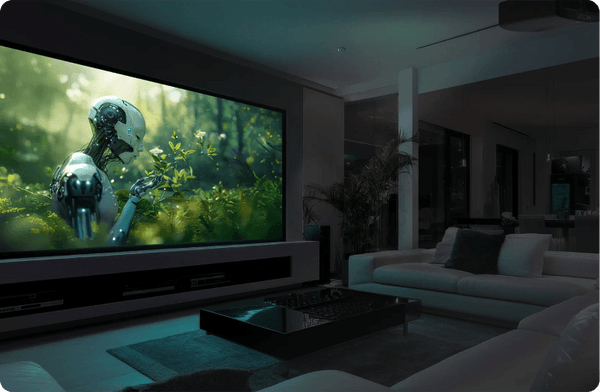

PROJECTORS FOR YOUR ROOM
A BIGGER PICTURE. THE RIGHT PROJECTOR.
Compare projectors for your space, screen size, and budget. Get expert help with the details that matter.
Explore Projector Types
Read the projector buying guide
Standard Throw Projectors
For rooms with space between the projector and screen.

Lifestyle Projectors
All-in-one entertainment with built-in speakers and streaming apps.

Ultra Short Throw Projectors
Place the projector close to the wall for a front-of-room setup.

Short Throw Projectors
Create a large picture from a shorter distance in smaller rooms.

Golf Simulator Projectors
Match your simulator screen, mounting position, and throw distance.

Optional Lens Projectors
Choose a compatible lens to suit your room and throw distance.

Large Venue Projectors
Explore options for auditoriums, events, and large screens.

Data Projectors
For presentations, spreadsheets, and classroom or business content.

Installation Projectors
For permanent setups that need precise mounting and integration.
Projectors
EXPERT HELP, BEFORE YOU BUY
GET THE SETUP RIGHT. THE FIRST TIME.
Tell us your room dimensions, light conditions, and budget. Our team can help match your projector, screen, and placement.
Talk to a Projection ExpertStart with the light
A dedicated dark room and a sunlit living room need different approaches.
Plan the placement
Throw distance determines where your projector can sit. Check it against your screen size before you buy.
Choose a compatible screen
Screen material and size work with your projector to shape the picture. Plan them together.
Buying questions answered
What makes a projector the best choice for a home theater?
For a light-controlled movie room, prioritize contrast, black levels, accurate color and HDR handling at the screen size you intend to use. For a multipurpose living room, also weigh usable brightness, light control and screen material. For frequent gaming, add latency and supported refresh rates to the shortlist. Compare models tested under similar conditions; a maximum-lumen specification or resolution label alone cannot identify a winner.
Further reading: Projector buying guide · Supporting guide · Supporting guide
How do I know whether a projector will fit my room?
Use image width and lens-to-screen distance to check throw ratio. For example, a 120-inch 16:9 image is about 104.6 inches wide. A lens 157 inches away needs a throw ratio of about 1.50:1. Check that the model supports that ratio, then separately allow for its body, ventilation, mounting position and lens offset. UST placement requires the model’s own dimension chart.
Further reading: Projector buying guide
How much brightness should I buy?
Brightness depends on image size, screen material, room light and the picture mode you will actually use. Compare measured output in comparable modes when reviews provide it; a maximum specification alone does not describe movie performance. A larger image spreads the same light over more area. Shade windows and redirect lamps before assuming a higher-lumen projector will solve washed-out blacks.
Further reading: Projector brightness guide
Which specifications matter for movies, gaming or presentations?
For movies, compare black levels, color accuracy and HDR handling. For gaming, check input lag at your intended resolution and refresh rate, including whether those features work together. For presentations, prioritize readable text, suitable connections and enough light for the room. Build a shortlist around your main use, then check the compromises for your secondary use.
Further reading: Projector buying guide
Is a projector better than a television?
A projector is worth considering when a large image is a priority and you can plan the room around it. A television may be easier for everyday viewing where strong ambient light cannot be controlled. Compare the complete projector system with the television you would otherwise buy. Include the screen, placement, audio and light control in that comparison. Judge both at your normal viewing time, rather than comparing diagonal size or brightness specifications alone.
Further reading: Projector buying guide · Projector brightness guide
How do I compare native contrast with a dynamic contrast claim?
Native contrast describes the difference between bright and dark output without relying on dynamic light-source or iris changes. Dynamic contrast may involve changing output between scenes and is often measured differently. Compare independent reviews of dark scenes, shadow detail and mixed bright-and-dark images under similar conditions. A very large dynamic ratio on a specification sheet does not tell you how much detail remains visible in a difficult movie scene.
Further reading: Projector buying guide
Do I need lens memory for a CinemaScope screen?
Lens memory can make switching image size and position easier when alternating wide movies and 16:9 programs, but the projector still needs enough optical zoom and shift for both layouts. Check whether the exact model stores the required adjustments and which functions are motorized. Decide how you will handle unused screen areas or masking. A memory feature cannot compensate for a lens that cannot form the required image from your mounting position.
Further reading: Projector buying guide
What should I budget for beyond the projector itself?
Allow for a compatible screen, mount or cabinet, signal cables, audio and installation. Include any electrical work or control equipment the room requires. Compare ongoing power use, cleaning, lamp or light-engine service and the actual warranty terms. A higher projector price may include features that avoid other purchases, while a lower price may require a lens, mount or streaming source sold separately. Compare complete working systems for the same room.
Further reading: Projector buying guide


