


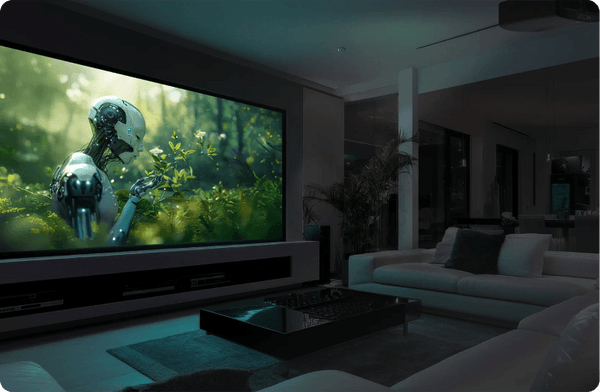
Ceiling Projector Screens
Buying questions answered
What is the difference between ceiling-mounted and ceiling-recessed screens?
A surface-mounted screen has a housing attached below the ceiling; a recessed housing is installed within it. Recessing requires enough cavity space, suitable support and a service plan. Compare the complete case dimensions and the lowered image position before choosing. Both approaches still require compatible screen material and projector placement.
Further reading: Screen buying guide
How do I know whether the image will lower far enough?
Check the model’s image height, top drop and permitted travel against the ceiling height and desired bottom edge. The diagonal size alone does not locate the image in the room. Mark the deployed outline and check sightlines, furniture and the projector beam before ordering.
Further reading: Screen buying guide
Can ceiling mounting hide the screen completely?
An exposed housing remains visible below the ceiling when the fabric is retracted. A recessed installation conceals the compatible housing within a prepared cavity and typically leaves its specified closure or trim visible. Compare appearance with the required structure and service access before choosing either arrangement.
Further reading: Screen buying guide
How does ceiling height affect the screen I should order?
Work from the desired image position, then add the viewable height and required top drop to locate the case. A high ceiling may require more drop than a standard configuration provides. Include the housing, brackets and bottom-bar travel in the drawing. Check the manufacturer’s maximum extension rather than assuming the fabric can always be lowered farther after installation.
Further reading: Screen buying guide
Can a ceiling screen lower in front of wall-mounted speakers or a television?
It can when the brackets or housing place the entire travel path far enough forward. Measure the deepest obstruction, include the bottom bar and allow the specified clearance. Check the screen material against anything bright or reflective behind it. A case that clears the television at the ceiling may still let the deployed fabric or bar collide with equipment below.
Further reading: Screen buying guide
What should remain accessible in a recessed ceiling installation?
Follow the screen’s service-access design for the motor, roller, electrical connection and control components. Check structural support, the ceiling opening and the space available above it as separate requirements. Decorative trim does not support the screen’s weight or provide a service route by itself. Resolve installation and maintenance access before closing the ceiling, especially for a screen with a long or heavy housing.
Further reading: Screen buying guide
Does ceiling mounting determine whether I need tensioning?
No. Tensioning relates to the deployed fabric and the projector’s sensitivity to surface shape. Consider the image size, material and throw geometry as well as the mounting position. A UST installation can make small waves more visible even when the housing is correctly supported. Compare the exact screen’s intended application rather than treating all ceiling-mounted screens as mechanically or optically equivalent.
Further reading: Screen buying guide
Which controls should I plan for a high-mounted screen?
Decide whether operation will use a wall control, remote or compatible automation connection, then confirm the motor and receiver requirements. Include the power entry and control cable route before fitting the housing. If the screen can be triggered by the projector, verify the supported voltage and adapter arrangement. The mounting height makes convenient independent control especially useful if another part of the system is unavailable.
Further reading: Screen buying guide


