


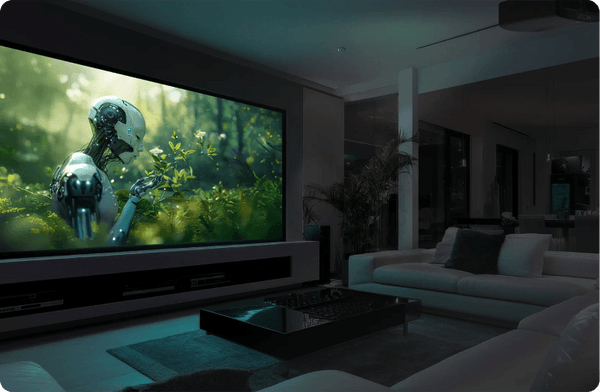
Video [4:3] Projector Screens
Buying questions answered
When should I choose a 4:3 screen?
Consider it for content and projection systems planned around a 4:3 image. Confirm how the projector will display both matching and differently shaped content. The ratio describes image shape, not resolution; preserving a full picture of another shape can leave unused parts of the screen.
Further reading: Screen buying guide
What are the dimensions of a 120-inch 4:3 image?
The calculated visible area is approximately 96.0 inches wide by 72.0 inches high. The calculation uses a 120-inch diagonal and the 4:3 ratio; it excludes borders, housing and mounting clearances. A different diagonal scales both dimensions proportionally. Compare these image dimensions with the complete product drawing before replacing a screen with another format.
Further reading: Screen buying guide
What happens when my content is a different shape from 4:3?
Preserving the full source without distortion can leave unused screen areas, while filling the surface may require supported cropping or scaling. Check the projector’s native format and the sources you use most often. Decide how the system will switch formats and handle unused borders before choosing the surface. A 4:3 screen does not change the shape of every movie, television program or presentation automatically.
Further reading: Screen buying guide · Projector buying guide
How do I calculate projector placement for a 4:3 screen?
Use the chosen image width, not diagonal, in the throw-ratio calculation. For the 120-inch 4:3 example, a 1.5:1 lens position would be about 144.0 inches from the image. Confirm the exact projector’s lens range, image-size limits and shift requirements. If you plan to zoom between content formats, verify both resulting image positions instead of checking just one.
Further reading: Projector buying guide · Screen buying guide
Does choosing 4:3 determine the screen material?
No. Aspect ratio describes image shape, while texture, gain, acoustic transparency and light rejection describe different surface properties. Choose a compatible material for the projector’s position, room light and seats, then order it in the required format. A 4:3 label is not a resolution rating or proof of UST compatibility. Fine pixel detail still needs a surface that preserves its geometry.
Further reading: Screen buying guide · Pixel geometry and screen texture


