


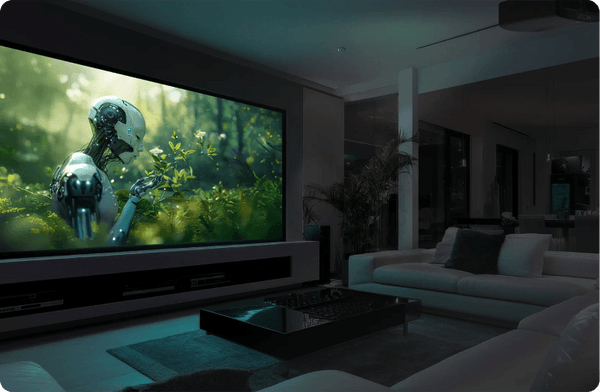
Borderless Projector Screens
Buying questions answered
Is a borderless screen easier to align?
A narrow visible border can make overspill and imperfect geometry more noticeable. Plan precise projector placement, a flat surface and the exact image size before choosing the aesthetic. A borderless label does not establish that the screen has no structural frame behind it.
Further reading: Screen buying guide
Does a borderless frame leave room for image overspill?
A narrow or borderless design provides less dark perimeter to absorb alignment errors than a wider black frame. Check the visible opening and align the projector physically before relying on digital correction. Plan what happens with differently shaped content and unused image areas. Choose the appearance alongside the required precision, rather than assuming a thin border improves the optical surface itself.
Further reading: Screen buying guide
Does borderless describe the screen material?
No. Frame style and surface construction are separate specifications. Check texture, gain, viewing-angle behavior and throw compatibility on the exact fabric. A slim frame can carry materials intended for different rooms. Choose the surface for the projector and light directions, then compare outside dimensions and assembly requirements for the frame.
Further reading: Screen buying guide
What should I inspect at the screen edges?
Check image alignment, surface tension and focus across the full opening from the intended seats. Use bright fields and fine detail as well as normal content. Confirm the assembled frame dimensions and mounting position before drilling. An edge-to-edge look should still preserve pixel detail and provide a stable flat surface for the selected projector.
Further reading: Screen buying guide
How should I compare the Borderless Projector Screens options?
For Borderless Projector Screens, compare the exact configurations rather than the category label alone. Current example listings include “Da-Lite FullVision FC13H58X104 - 119" diag.(58x104) - [16:9] - HD Progressive 1.3” and “Da-Lite FullVision FC11C58X104 - 119" diag.(58x104) - [16:9] - HD Progressive 1.1 Contrast”. Use their individual specifications to separate differences in size, construction, source compatibility or supplied components. Start with the configuration that solves the job in your room, then compare the relevant alternatives. Collection membership is not verification of every feature implied by the category name.
Further reading: Product specifications · Product specifications


